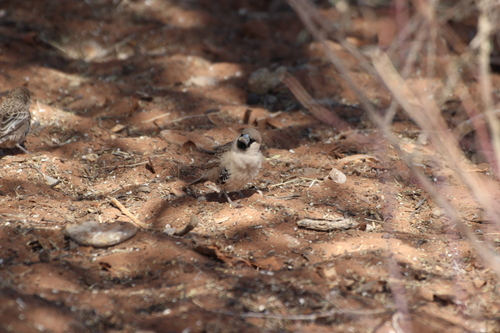
Scaly Weaver vs Sociable Weaver
Sporopipes squamifrons versus Philetairus socius
Play a quiz with Scaly Weaver and Sociable Weaver
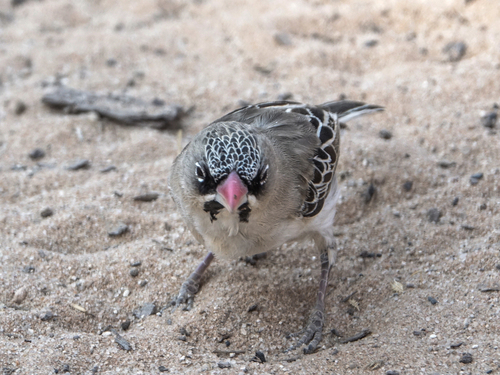
Scaly Weaver
Sociable Weaver
In short
The Sociable Weaver and the Scaly Weaver are both small, finch-like birds with notable differences in plumage, vocalizations, and behavior. The Sociable Weaver has a more uniform sandy brown coloration with a distinctive black throat patch, while the Scaly Weaver features a striking black-and-white forehead and a rose-pink bill. Additionally, their vocalizations and social behaviors differ, with the Sociable Weaver exhibiting a more complex song structure.
Identification tips
- Birds of the World Similar-Species Diagnostics:
-
The Scaly Weaver is described as "unmistakable" due to its "scaly, black-and-white forehead and forecrown" and "distinctive malar stripes," as well as a "rose-pink bill." Juveniles have distinctive features like brown malar stripes and a dull gray-brown crown (source: Birds of the World).
-
AI Field Diagnostics:
- Plumage: Look for the Sociable Weaver’s black throat patch, which is absent in the Scaly Weaver. The Scaly Weaver’s unique black-and-white facial features and rose-pink bill are also key identifiers.
- Behavior: The Sociable Weaver’s tendency to form large colonies and engage in complex vocalizations is notable. If you observe a bird in a large group with intricate songs, it is likely a Sociable Weaver. In contrast, Scaly Weavers are usually in smaller groups and exhibit simpler calls.
- Habitat: Pay attention to where you see them. Sociable Weavers build large communal nests and are often found in trees, while Scaly Weavers may be seen in pairs amid bushy areas.
- Juvenile Identification: Juvenile Sociable Weavers can be confused with Scaly Weavers, so note the lack of a black throat patch in juveniles and the presence of speckling on the forehead and crown of Sociable Weavers, which is less pronounced in juvenile Scaly Weavers.
By focusing on these distinguishing features, birdwatchers can effectively differentiate between the Sociable Weaver and Scaly Weaver in the field.
Size
Both species measure approximately 14 cm in length and weigh between 24-32 g. Their body proportions appear similar, characterized by a compact, finch-like shape.
Plumage
-
Sociable Weaver: This species has sandy brown upperparts with dark brown hindneck and a scalloped effect from pale feather edges. The cheeks are cream with a brownish wash, and the most distinctive feature is a black patch from the lores to the throat. The breast and belly are cream-colored, often with a brownish wash, and the flanks have black patches with white-edged feathers. Juveniles lack the black throat patch and have a pale horn bill.
-
Scaly Weaver: In contrast, the Scaly Weaver displays a scaly black-and-white forehead and forecrown, with a distinct rose-pink bill. The lores are black, and it has malar stripes that enhance its facial pattern. Juveniles have brown malar stripes, a dull gray-brown crown, and a less pronounced scaliness on the forehead, with a yellow horn bill.
Behaviour
-
Sociable Weaver: Known for its sociable nature, this species often forms large colonies and exhibits complex social behavior. Vocalizations are primarily made by high-ranking males, with a series of rapid notes used for communication, especially in flight.
-
Scaly Weaver: Also gregarious, Scaly Weavers are typically seen in pairs or small groups. Their behavior includes foraging predominantly for seeds, and they are less known for complex vocalization compared to the Sociable Weaver.
Habitat
-
Sociable Weaver: Prefers arid and semi-arid habitats, often found in savannahs and grasslands of southern Africa. They build large, communal nests in trees or shrubs.
-
Scaly Weaver: Inhabits drier regions of southern Africa, specifically in bushy areas and grasslands, but may not be as dependent on large trees for nesting as the Sociable Weaver.
Voice
-
Sociable Weaver: Vocalizations include a chatter of around 10 initial notes in their song, followed by paired elements. They also have a complex series of rapid notes during flight and a harsh alarm call.
-
Scaly Weaver: Vocalizations are not as extensively documented, but they are generally less complex than those of the Sociable Weaver, focusing more on contact calls.