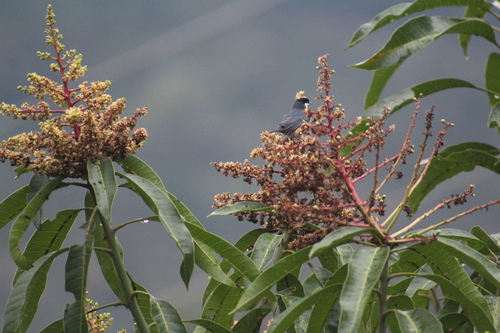
Birdr

Scarlet-browed Tanager vs White-eared Conebill

Heterospingus xanthopygius versus Conirostrum leucogenys

Play a quiz with Scarlet-browed Tanager and White-eared Conebill
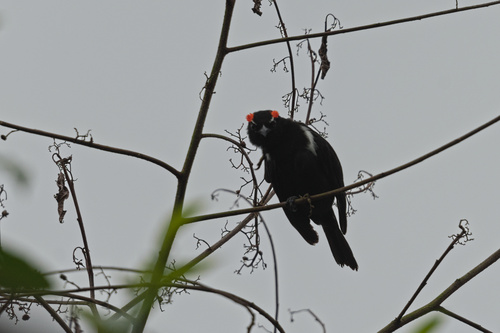
Scarlet-browed Tanager (Heterospingus xanthopygius) Scarlet-browed Tanager
White-eared Conebill (Conirostrum leucogenys) White-eared Conebill

Media

Loading…

In short

The Scarlet-browed Tanager is distinguished by its solid dark color with a yellow rump and a red stripe behind the eye in males, while the White-eared Conebill is bluish gray with pale yellowish buff underparts and a distinctive white ear patch. Both species belong to the tanager family but differ significantly in plumage and habitat preferences.

Identification tips

  1. Look for the red stripe behind the eye in male Scarlet-browed Tanagers. 2. Check for the white ear patch in White-eared Conebills. 3. Note the yellow rump of the Scarlet-browed Tanager. 4. Observe the overall bluish gray color of the White-eared Conebill. 5. Consider habitat: Scarlet-browed Tanager in canopy, White-eared Conebill below 800 m.

Size

Both species are small tanagers, but the Scarlet-browed Tanager is generally more robust compared to the slender White-eared Conebill.

Plumage

Scarlet-browed Tanager: Solid dark plumage with a yellow rump and a red stripe behind the eye in males. White-eared Conebill: Bluish gray above, pale yellowish buff on the face and underparts, with a white ear patch.

Behaviour

Scarlet-browed Tanagers often sit on exposed branches and forage in the canopy, while White-eared Conebills are typically seen in pairs and may be more active in lower strata.

Habitat

Scarlet-browed Tanagers are found high in the canopy, often in mixed flocks, while White-eared Conebills are found below 800 m in northern Colombia, Venezuela, and parts of Panama.

Voice

Scarlet-browed Tanager call: a low, squeaky 'chyup'. White-eared Conebill vocalizations are not detailed here.

Submit a better description

Use the same sections as the comparison. Your text is published immediately.

The Scarlet-browed Tanager is distinguished by its solid dark color with a yellow rump and a red stripe behind the eye in males, while the White-eared Conebill is bluish gray with pale yellowish buff underparts and a distinctive white ear patch. Both species belong to the tanager family but differ significantly in plumage and habitat preferences.

  1. Look for the red stripe behind the eye in male Scarlet-browed Tanagers. 2. Check for the white ear patch in White-eared Conebills. 3. Note the yellow rump of the Scarlet-browed Tanager. 4. Observe the overall bluish gray color of the White-eared Conebill. 5. Consider habitat: Scarlet-browed Tanager in canopy, White-eared Conebill below 800 m.

Both species are small tanagers, but the Scarlet-browed Tanager is generally more robust compared to the slender White-eared Conebill.

Scarlet-browed Tanager: Solid dark plumage with a yellow rump and a red stripe behind the eye in males. White-eared Conebill: Bluish gray above, pale yellowish buff on the face and underparts, with a white ear patch.

Scarlet-browed Tanagers often sit on exposed branches and forage in the canopy, while White-eared Conebills are typically seen in pairs and may be more active in lower strata.

Scarlet-browed Tanagers are found high in the canopy, often in mixed flocks, while White-eared Conebills are found below 800 m in northern Colombia, Venezuela, and parts of Panama.

Scarlet-browed Tanager call: a low, squeaky 'chyup'. White-eared Conebill vocalizations are not detailed here.

Discard your changes?

You have unsaved edits. If you leave now, those changes will be lost.

Scarlet-browed Tanager · White-eared Conebill · My Tricky Birds