Birdr

Scissor-tailed Flycatcher vs Black-capped Vireo

Tyrannus forficatus versus Vireo atricapilla

Play a quiz with Scissor-tailed Flycatcher and Black-capped Vireo
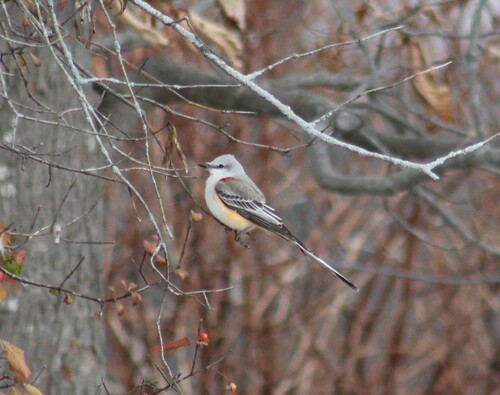
Scissor-tailed Flycatcher (Tyrannus forficatus) Scissor-tailed Flycatcher
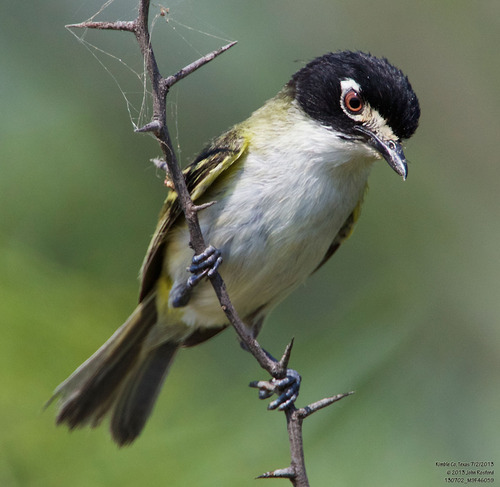
Black-capped Vireo (Vireo atricapilla) Black-capped Vireo

Media

Loading…

In short

The Scissor-tailed Flycatcher and Black-capped Vireo are distinct in both appearance and behavior. The Scissor-tailed Flycatcher is notable for its extremely long, forked tail, while the Black-capped Vireo is recognized by its black cap and contrasting white face. Their habitats and vocalizations also differ significantly.

Identification tips

1. Tail: Look for the Scissor-tailed Flycatcher's long, forked tail, a key distinguishing feature. 2. Head: Check for the Black-capped Vireo's black cap and white face. 3. Size and Shape: Note the larger size and elongated shape of the Scissor-tailed Flycatcher compared to the smaller, more compact Black-capped Vireo. 4. Habitat: Consider the habitat; open grasslands suggest Scissor-tailed Flycatcher, while dense scrub indicates Black-capped Vireo. 5. Song: Listen for the Black-capped Vireo's persistent and varied song.

Size

The Scissor-tailed Flycatcher is larger with a more elongated body and tail, while the Black-capped Vireo is smaller and more compact.

Plumage

The Scissor-tailed Flycatcher has a pale gray body with salmon-pink sides and a strikingly long, forked tail. In contrast, the Black-capped Vireo features a distinctive black cap, white face, and olive-green upperparts.

Behaviour

Scissor-tailed Flycatchers are often seen performing graceful aerial maneuvers to catch insects, whereas Black-capped Vireos are more likely to be observed foraging in dense shrubbery.

Habitat

Scissor-tailed Flycatchers prefer open grasslands with scattered trees, while Black-capped Vireos inhabit scrubby areas and thickets in their limited range.

Voice

The Scissor-tailed Flycatcher's calls are less notable, whereas the Black-capped Vireo is known for its persistent and varied singing, especially during the breeding season.

Submit a better description

Use the same sections as the comparison. Your text is published immediately.

The Scissor-tailed Flycatcher and Black-capped Vireo are distinct in both appearance and behavior. The Scissor-tailed Flycatcher is notable for its extremely long, forked tail, while the Black-capped Vireo is recognized by its black cap and contrasting white face. Their habitats and vocalizations also differ significantly.

1. Tail: Look for the Scissor-tailed Flycatcher's long, forked tail, a key distinguishing feature. 2. Head: Check for the Black-capped Vireo's black cap and white face. 3. Size and Shape: Note the larger size and elongated shape of the Scissor-tailed Flycatcher compared to the smaller, more compact Black-capped Vireo. 4. Habitat: Consider the habitat; open grasslands suggest Scissor-tailed Flycatcher, while dense scrub indicates Black-capped Vireo. 5. Song: Listen for the Black-capped Vireo's persistent and varied song.

The Scissor-tailed Flycatcher is larger with a more elongated body and tail, while the Black-capped Vireo is smaller and more compact.

The Scissor-tailed Flycatcher has a pale gray body with salmon-pink sides and a strikingly long, forked tail. In contrast, the Black-capped Vireo features a distinctive black cap, white face, and olive-green upperparts.

Scissor-tailed Flycatchers are often seen performing graceful aerial maneuvers to catch insects, whereas Black-capped Vireos are more likely to be observed foraging in dense shrubbery.

Scissor-tailed Flycatchers prefer open grasslands with scattered trees, while Black-capped Vireos inhabit scrubby areas and thickets in their limited range.

The Scissor-tailed Flycatcher's calls are less notable, whereas the Black-capped Vireo is known for its persistent and varied singing, especially during the breeding season.

Discard your changes?

You have unsaved edits. If you leave now, those changes will be lost.

Scissor-tailed Flycatcher · Black-capped Vireo · My Tricky Birds