
Scottish Crossbill vs Common Crossbill
Loxia scotica versus Loxia curvirostra
Play a quiz with Scottish Crossbill and Common Crossbill
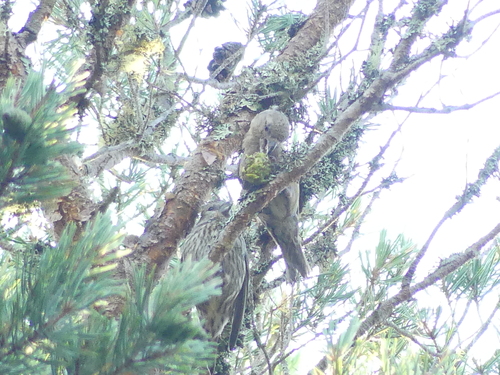 Scottish Crossbill
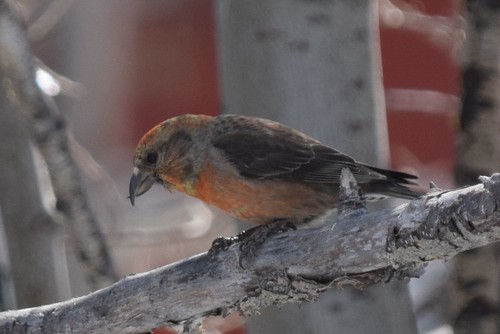 Common Crossbill
In short
Scottish Crossbill and Common Crossbill are nearly impossible to distinguish by plumage alone, even at close range, as both share the characteristic crossed bill and similar coloration in all ages and sexes. The most reliable field mark is the call: Scottish Crossbill has a distinctive 'jip' call, but even this is best confirmed by sonogram analysis. Bill size is slightly larger on average in Scottish, but the ranges overlap heavily, making it unreliable in the field. Both species can show red/orange males and green/yellow females, and their structure and jizz are very similar. Unless you are in the heart of the Scottish Highlands and can record calls, separating these two in the field is extremely challenging.
Identification tips
- Calls are key: The only consistently reliable field mark is the call. Scottish Crossbill has a distinctive 'jip' call, but this is best confirmed by recording and sonogram analysis. Field separation by ear is very difficult due to overlap and variation.
- Bill size overlap: Scottish Crossbill averages a slightly larger and deeper bill than Common Crossbill, but the ranges overlap so much that bill size is not a safe field mark unless you have a large sample or direct comparison with known individuals.
- Plumage is not helpful: Both species show red/orange males, green/yellow females, and streaky greyish juveniles. There are no consistent differences in wing, tail, or body plumage at any age.
- No diagnostic wing pattern: Neither species shows wing bars or contrasting panels; both have plain brownish-black wings in all ages and sexes.
- Habitat context: Scottish Crossbill is restricted to the Caledonian pine forests of the Scottish Highlands, but Common Crossbill can also be present there, especially in irruption years. If you are outside the Highlands, Scottish Crossbill is extremely unlikely.
- Flock composition: Both species may flock together, especially outside the breeding season, so mixed flocks are possible and do not aid identification.
- Feeding behavior: Both species feed in the same way, prying open conifer cones with their crossed bills. Feeding technique is not a separator.
- Jizz and structure: Overall size, shape, and posture are indistinguishable in the field. Bill size is only marginally helpful and only in direct comparison with known birds.
- Sex and age variation: Both species show wide variation in color and bill shape by age and sex, but these variations overlap extensively between the two.
- Irruptive behavior: Common Crossbill is highly irruptive and may appear in large numbers far from breeding areas, but Scottish Crossbill is more sedentary. However, this is not a reliable mark for a single bird.
- Recording calls: If you suspect Scottish Crossbill, try to record the call for later sonogram analysis, as this is the only way to confirm identification in most cases.
- Conservation status: Scottish Crossbill is of high conservation concern and endemic to Scotland, so extra care should be taken before claiming a sighting.
- Beware of hybrids and introgression: The two species are reproductively isolated, but the possibility of hybrids or misidentification with Parrot Crossbill further complicates field ID.
- Do not rely on field guides alone: Most field guides admit that separation is nearly impossible without call analysis.
- When in doubt, leave unidentified: If you cannot confirm the call, it is best to leave the bird as 'crossbill sp.' rather than risk a misidentification.
Size
Scottish Crossbill averages 43g in body mass, which is within the range of Common Crossbill, though precise comparative weights are not given. Structurally, Scottish Crossbill's bill is intermediate in size between Common and Parrot Crossbill, but there is extensive overlap, so size is not a reliable field mark. Both species are small, robust finches with similar proportions.
Plumage
There are no consistent plumage differences between Scottish and Common Crossbill at any age. Both species have brownish-black wings without wing bars, and both sexes and all ages can show considerable variation in body color, from red/orange in males to green/yellow in females, with juveniles being greyish-green and streaked. No distinctive juvenile or immature upperwing patterns are noted for either species. Individual variation within each species exceeds any differences between them.
Behaviour
Both species are highly specialized for feeding on conifer cones, using their crossed mandibles to extract seeds. Their foraging behavior, flight style, and flocking tendencies are similar. Scottish Crossbill is more likely to be resident and tied to local pine forests, while Common Crossbill is more irruptive and nomadic, but this is not a reliable field mark in a single encounter.
Habitat
Scottish Crossbill is endemic to the Caledonian pine forests of the Scottish Highlands, often in native Scots pine and sometimes in plantations of larch and lodgepole pine. Common Crossbill is much more widespread, breeding in a variety of coniferous forests across Eurasia and North America, and is highly irruptive, appearing where cone crops are abundant. In Scotland, both species can occur together, so habitat alone is not diagnostic, but Scottish Crossbill is restricted to the Highlands.
Voice
The most reliable difference is in the call: Scottish Crossbill gives a metallic 'jip' call, which is distinct from the various call types of Common Crossbill. However, these differences are subtle and typically require recording and sonogram analysis for confirmation. Both species are highly variable in call, and field identification by ear alone is not recommended unless you are highly experienced and familiar with local call types.