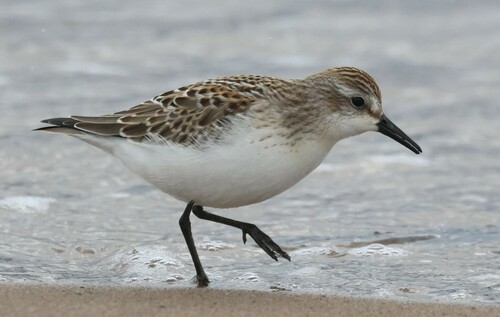
Semipalmated Plover vs Semipalmated Sandpiper
Charadrius semipalmatus versus Calidris pusilla
Play a quiz with Semipalmated Plover and Semipalmated Sandpiper

Semipalmated Plover
Semipalmated Sandpiper
In short
The Semipalmated Plover and Semipalmated Sandpiper are both small shorebirds, but they differ significantly in structure and plumage. The plover has a distinct black neck band and a short, stout bill, while the sandpiper has a longer, slender bill and lacks the neck band.
Identification tips
- Look for the black neck band on the Semipalmated Plover, which the sandpiper lacks. 2. Note the bill shape: the plover's bill is short and stout, while the sandpiper's is longer and more slender. 3. Observe the plumage: the plover has a more contrasting pattern with a clear neck band, whereas the sandpiper is more uniformly colored. 4. Listen for vocalizations: the plover's call is a clear whistle, distinct from the sandpiper's softer twittering.
Size
The Semipalmated Plover is slightly larger and stockier than the Semipalmated Sandpiper.
Plumage
The Semipalmated Plover has a brown back, white underparts, and a distinctive black neck band. In contrast, the Semipalmated Sandpiper has a more uniform brownish-gray plumage without a neck band, and its underparts are also white.
Behaviour
Both species are often seen foraging along shorelines, but the Semipalmated Sandpiper tends to be more gregarious, often found in large flocks, whereas the Semipalmated Plover is more solitary or in small groups.
Habitat
The Semipalmated Plover is typically found in open sites near sub-arctic lakes and rivers, while the Semipalmated Sandpiper frequents mudflats and sandy beaches during migration.
Voice
The Semipalmated Plover has a clear, whistled call, while the Semipalmated Sandpiper's call is a softer, more twittering sound.
Semipalmated Plover · Semipalmated Sandpiper · My Tricky Birds