
Semipalmated Sandpiper vs Cream-coloured Courser
Calidris pusilla versus Cursorius cursor
Play a quiz with Semipalmated Sandpiper and Cream-coloured Courser
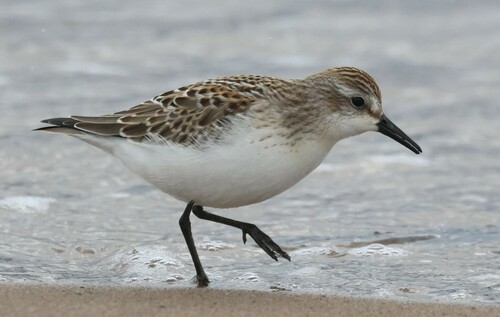
Semipalmated Sandpiper
Cream-coloured Courser
In short
The Semipalmated Sandpiper and Cream-coloured Courser are distinct in both appearance and habitat. The Semipalmated Sandpiper is a small, migratory shorebird with partial webbing between its toes, while the Cream-coloured Courser is a terrestrial bird with a distinctive sandy coloration and long legs.
Identification tips
Look for the partial webbing on the toes of the Semipalmated Sandpiper, a key feature not present in the Cream-coloured Courser. Note the sandy coloration and long legs of the Cream-coloured Courser, which contrast with the smaller, more compact Semipalmated Sandpiper. Habitat is a strong clue: Semipalmated Sandpipers are found near water, while Cream-coloured Coursers are in dry, open areas.
Size
The Semipalmated Sandpiper is smaller and more compact, whereas the Cream-coloured Courser is larger with longer legs and a more upright posture.
Plumage
Semipalmated Sandpipers have a grayish-brown plumage with a white underbelly and a short, straight bill. Cream-coloured Coursers are sandy-colored with a striking black eye stripe and a white supercilium.
Behaviour
Semipalmated Sandpipers are often seen in flocks along shorelines, foraging in mudflats. Cream-coloured Coursers are typically found in pairs or small groups, running on open, arid ground.
Habitat
Semipalmated Sandpipers inhabit coastal mudflats and estuaries during migration. Cream-coloured Coursers prefer dry, open habitats such as deserts and semi-deserts.
Voice
Vocalizations are not a primary distinguishing feature between these species in the field.
Semipalmated Sandpiper · Cream-coloured Courser · My Tricky Birds