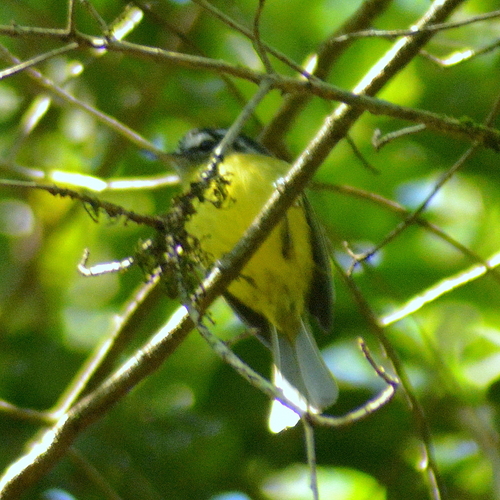
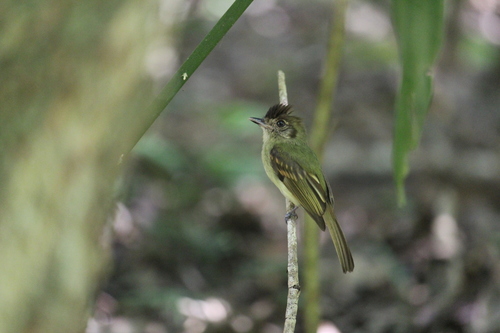
Sepia-capped Flycatcher vs Southern Bristle-Tyrant
Leptopogon amaurocephalus versus Pogonotriccus eximius
Play a quiz with Sepia-capped Flycatcher and Southern Bristle-Tyrant
Sepia-capped Flycatcher
Southern Bristle-Tyrant
In short
The Sepia-capped Flycatcher and Southern Bristle-Tyrant are both small, insectivorous flycatchers, but they can be distinguished by their head coloration and behavior. The Sepia-capped Flycatcher has a distinctive dark cheek patch with a pale fringe, while the Southern Bristle-Tyrant lacks this feature. Both species are found in similar habitats, but their vocalizations and specific behaviors can help differentiate them.
Identification tips
1. Look for the dark cheek patch with a pale fringe on the Sepia-capped Flycatcher. 2. Observe behavior: Sepia-capped Flycatcher may lift a wing over its back. 3. Listen for vocalizations: Sepia-capped Flycatcher has loud, explosive calls. 4. Note the habitat: both species can be found in mixed flocks, so pay attention to head patterns and behaviors.
Size
Both species are similar in size, typical of small flycatchers.
Plumage
The Sepia-capped Flycatcher has a dark cheek patch with a pale fringe and a pale 'tear-drop' mark, giving it a distinctive facial pattern. The Southern Bristle-Tyrant lacks this cheek patch and has a more uniform head coloration.
Behaviour
Sepia-capped Flycatcher often lifts one wing over its back while perched and feeds by hover-gleaning. The Southern Bristle-Tyrant's behavior is less distinctive in this regard.
Habitat
Both species inhabit similar regions from Mexico to northern Argentina, often associating with mixed flocks in forested areas.
Voice
The Sepia-capped Flycatcher has explosive vocalizations that might be mistaken for a larger bird, while the Southern Bristle-Tyrant's calls are less well-documented.
Sepia-capped Flycatcher · Southern Bristle-Tyrant · My Tricky Birds