Birdr

Sharp-tailed Sandpiper vs Temminck's Stint

Calidris acuminata versus Calidris temminckii

Play a quiz with Sharp-tailed Sandpiper and Temminck's Stint
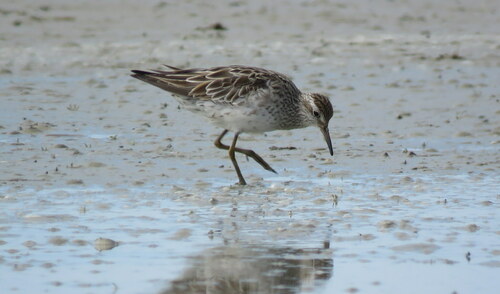
Sharp-tailed Sandpiper (Calidris acuminata) Sharp-tailed Sandpiper
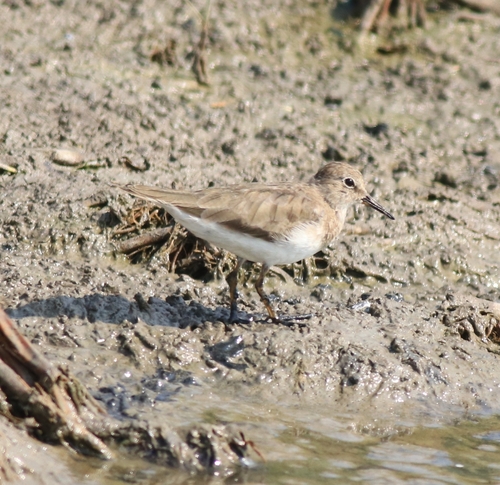
Temminck's Stint (Calidris temminckii) Temminck's Stint

Media

Loading…

In short

Sharp-tailed Sandpiper and Temminck's Stint can be distinguished by size and tail markings. Sharp-tailed Sandpiper is larger with a more pronounced supercilium, while Temminck's Stint has broad white sides to its tail and rump.

Identification tips

  1. Size: Sharp-tailed Sandpiper is larger. 2. Tail and Rump: Look for broad white sides on Temminck's Stint. 3. Supercilium: Sharp-tailed Sandpiper has a more pronounced supercilium. 4. Vocalization: Listen for the trilling song of Temminck's Stint during display flights.

Size

Sharp-tailed Sandpiper is larger than Temminck's Stint. Temminck's Stint measures 13–15 cm in length.

Plumage

Sharp-tailed Sandpiper has a more pronounced supercilium and a rufous crown in breeding plumage. Temminck's Stint has broad white sides to the tail and rump, and its non-breeding plumage is plain dark grey with a uniform pale grey-brown breast.

Behaviour

Temminck's Stint often performs display flights with a unique trilling call, while Sharp-tailed Sandpiper's behavior is less documented in this context.

Habitat

Both species can be found in similar habitats, but Temminck's Stint is more likely to be seen in inland wetlands and coastal areas during migration.

Voice

Temminck's Stint gives a distinctive 'tirr' or 'trrrrit' call and a trilling song during display flights. Sharp-tailed Sandpiper's vocalizations are less distinct in the field.

Submit a better description

Use the same sections as the comparison. Your text is published immediately.

Sharp-tailed Sandpiper and Temminck's Stint can be distinguished by size and tail markings. Sharp-tailed Sandpiper is larger with a more pronounced supercilium, while Temminck's Stint has broad white sides to its tail and rump.

  1. Size: Sharp-tailed Sandpiper is larger. 2. Tail and Rump: Look for broad white sides on Temminck's Stint. 3. Supercilium: Sharp-tailed Sandpiper has a more pronounced supercilium. 4. Vocalization: Listen for the trilling song of Temminck's Stint during display flights.

Sharp-tailed Sandpiper is larger than Temminck's Stint. Temminck's Stint measures 13–15 cm in length.

Sharp-tailed Sandpiper has a more pronounced supercilium and a rufous crown in breeding plumage. Temminck's Stint has broad white sides to the tail and rump, and its non-breeding plumage is plain dark grey with a uniform pale grey-brown breast.

Temminck's Stint often performs display flights with a unique trilling call, while Sharp-tailed Sandpiper's behavior is less documented in this context.

Both species can be found in similar habitats, but Temminck's Stint is more likely to be seen in inland wetlands and coastal areas during migration.

Temminck's Stint gives a distinctive 'tirr' or 'trrrrit' call and a trilling song during display flights. Sharp-tailed Sandpiper's vocalizations are less distinct in the field.

Discard your changes?

You have unsaved edits. If you leave now, those changes will be lost.

Sharp-tailed Sandpiper · Temminck's Stint · My Tricky Birds