Birdr

Shiny Cowbird vs Chopi Blackbird

Molothrus bonariensis versus Gnorimopsar chopi

Play a quiz with Shiny Cowbird and Chopi Blackbird
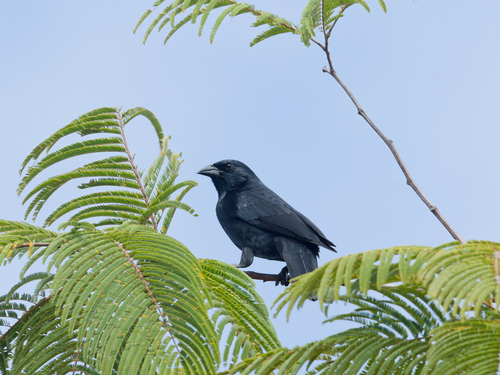
Shiny Cowbird (Molothrus bonariensis) Shiny Cowbird
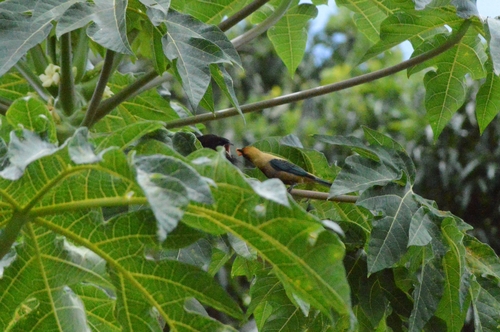
Chopi Blackbird (Gnorimopsar chopi) Chopi Blackbird

Media

Loading…

In short

The most reliable field mark to separate Shiny Cowbird from Chopi Blackbird is overall structure and bill shape: Shiny Cowbird is noticeably smaller, with a more delicate, slender bill and a flatter head, while Chopi Blackbird is larger and bulkier with a distinctly curved bill featuring a groove along the lower mandible. Adult male Shiny Cowbirds show a glossy purple-blue iridescence, whereas Chopi Blackbirds are a uniform black without strong iridescence. Females and immatures of Shiny Cowbird are dull brownish and much paler than any Chopi Blackbird. In the field, pay close attention to size, head and bill shape, and, for females, the much paler and browner coloration of the cowbird. Vocalizations are also quite different, with Chopi Blackbird giving loud, explosive calls.

Identification tips

  1. Size: Chopi Blackbird is much larger and bulkier than Shiny Cowbird. Use this mark when both species are present or compared to other icterids.
  2. Bill shape: Chopi Blackbird has a long, slightly curved bill with a groove along the lower mandible; Shiny Cowbird's bill is shorter, finer, and more pointed. This is especially helpful when birds are perched.
  3. Head profile: Shiny Cowbird has a flatter head, while Chopi Blackbird's head is more robust and rounded.
  4. Male plumage: Adult male Shiny Cowbird is glossy black with purple-blue iridescence, while Chopi Blackbird is plain black without strong iridescence. In good light, look for the sheen.
  5. Female/immature plumage: Female and immature Shiny Cowbirds are dull brownish or gray-brown, paler below, and never truly black. Chopi Blackbird is always black, regardless of age or sex. This is the best mark for separating females/immatures.
  6. Tail length: Chopi Blackbird has a proportionally longer tail than Shiny Cowbird, which can be seen in flight or when perched.
  7. Behavior: Shiny Cowbird is more likely to be seen foraging on the ground in open, disturbed areas. Chopi Blackbird is more arboreal and often perches conspicuously.
  8. Vocalizations: Chopi Blackbird's loud, explosive 'tjouw' call is diagnostic. Shiny Cowbird's song is softer and more musical, often given during display.
  9. Habitat: Shiny Cowbird prefers disturbed, agricultural, or pastureland, while Chopi Blackbird is more common in natural savannas and forest edges.
  10. Social context: Shiny Cowbird is often found in small groups or mixed flocks, especially with other cowbirds. Chopi Blackbird may form larger, noisier flocks.
  11. Courtship display: Male Shiny Cowbird may bow and ruffle feathers during display, but this is not likely to be confused with Chopi Blackbird.
  12. Bill color: Both species have dark bills, so this is not helpful.
  13. Flight style: Chopi Blackbird appears heavier and more direct in flight; Shiny Cowbird is lighter and more agile.
  14. Egg-laying behavior: Only Shiny Cowbird is a brood parasite, but this is not a field mark.
  15. Geographic context: In the far north of South America or the Caribbean, Chopi Blackbird is absent, so any similar bird is likely Shiny Cowbird.

Size

Shiny Cowbird is significantly smaller and lighter (body mass ~37 g) than Chopi Blackbird, which is about 25 cm in length and noticeably bulkier. The difference is especially apparent when both species are seen together or compared to other icterids: Chopi Blackbird is closer in size to a grackle, while Shiny Cowbird is more starling-sized. This size gap is a strong clue, especially at a distance or in mixed flocks.

Plumage

Adult male Shiny Cowbird is glossy black with a purple-blue iridescence, while Chopi Blackbird is a uniform black without pronounced iridescence. Female and immature Shiny Cowbirds are dull gray-brown, sometimes paler below, and much lighter than any Chopi Blackbird. Chopi Blackbird of both sexes and all ages is always black, lacking the brownish or grayish tones of female/immature cowbirds. No distinctive juvenile or immature wing patterns are described for either species, so focus on overall color and gloss. In flight, both appear blackish, but the cowbird's smaller size and shorter tail are apparent. Female Shiny Cowbird can be confused with other cowbirds, but is much paler and smaller-billed than Chopi Blackbird.

Behaviour

Shiny Cowbird is often seen foraging on the ground, sometimes around cattle or in open disturbed habitats, and is usually in small groups or mixed flocks. Chopi Blackbird is also social but tends to be more arboreal and is often seen perched conspicuously, sometimes in larger, noisier groups. The cowbird's movements are more furtive and less bold than the chopi's. During courtship, male Shiny Cowbird may display by bowing and ruffling feathers, but this is unlikely to be confused with Chopi Blackbird's behavior.

Habitat

Both species occur in open or semi-open habitats, but Shiny Cowbird is more closely associated with disturbed land, agricultural areas, and pastures, especially where it can parasitize nests of other birds. Chopi Blackbird is found south of the Amazon in a variety of open and semi-open habitats, but is less tied to human disturbance and more likely to be seen in natural savannas or forest edges. Range overlap is broad in southern South America, but habitat preference may help in ambiguous cases.

Voice

Chopi Blackbird has a loud, explosive 'tjouw' call, often repeated in irregular series and varying in pitch. This call is distinctive and much louder and harsher than any Shiny Cowbird vocalization. Shiny Cowbird's song is softer and more musical, used in courtship displays, and is not likely to be confused with the chopi's explosive calls. If you hear the 'tjouw' call, it is diagnostic for Chopi Blackbird.

Submit a better description

Use the same sections as the comparison. Your text is published immediately.

The most reliable field mark to separate Shiny Cowbird from Chopi Blackbird is overall structure and bill shape: Shiny Cowbird is noticeably smaller, with a more delicate, slender bill and a flatter head, while Chopi Blackbird is larger and bulkier with a distinctly curved bill featuring a groove along the lower mandible. Adult male Shiny Cowbirds show a glossy purple-blue iridescence, whereas Chopi Blackbirds are a uniform black without strong iridescence. Females and immatures of Shiny Cowbird are dull brownish and much paler than any Chopi Blackbird. In the field, pay close attention to size, head and bill shape, and, for females, the much paler and browner coloration of the cowbird. Vocalizations are also quite different, with Chopi Blackbird giving loud, explosive calls.

  1. Size: Chopi Blackbird is much larger and bulkier than Shiny Cowbird. Use this mark when both species are present or compared to other icterids.
  2. Bill shape: Chopi Blackbird has a long, slightly curved bill with a groove along the lower mandible; Shiny Cowbird's bill is shorter, finer, and more pointed. This is especially helpful when birds are perched.
  3. Head profile: Shiny Cowbird has a flatter head, while Chopi Blackbird's head is more robust and rounded.
  4. Male plumage: Adult male Shiny Cowbird is glossy black with purple-blue iridescence, while Chopi Blackbird is plain black without strong iridescence. In good light, look for the sheen.
  5. Female/immature plumage: Female and immature Shiny Cowbirds are dull brownish or gray-brown, paler below, and never truly black. Chopi Blackbird is always black, regardless of age or sex. This is the best mark for separating females/immatures.
  6. Tail length: Chopi Blackbird has a proportionally longer tail than Shiny Cowbird, which can be seen in flight or when perched.
  7. Behavior: Shiny Cowbird is more likely to be seen foraging on the ground in open, disturbed areas. Chopi Blackbird is more arboreal and often perches conspicuously.
  8. Vocalizations: Chopi Blackbird's loud, explosive 'tjouw' call is diagnostic. Shiny Cowbird's song is softer and more musical, often given during display.
  9. Habitat: Shiny Cowbird prefers disturbed, agricultural, or pastureland, while Chopi Blackbird is more common in natural savannas and forest edges.
  10. Social context: Shiny Cowbird is often found in small groups or mixed flocks, especially with other cowbirds. Chopi Blackbird may form larger, noisier flocks.
  11. Courtship display: Male Shiny Cowbird may bow and ruffle feathers during display, but this is not likely to be confused with Chopi Blackbird.
  12. Bill color: Both species have dark bills, so this is not helpful.
  13. Flight style: Chopi Blackbird appears heavier and more direct in flight; Shiny Cowbird is lighter and more agile.
  14. Egg-laying behavior: Only Shiny Cowbird is a brood parasite, but this is not a field mark.
  15. Geographic context: In the far north of South America or the Caribbean, Chopi Blackbird is absent, so any similar bird is likely Shiny Cowbird.

Shiny Cowbird is significantly smaller and lighter (body mass ~37 g) than Chopi Blackbird, which is about 25 cm in length and noticeably bulkier. The difference is especially apparent when both species are seen together or compared to other icterids: Chopi Blackbird is closer in size to a grackle, while Shiny Cowbird is more starling-sized. This size gap is a strong clue, especially at a distance or in mixed flocks.

Adult male Shiny Cowbird is glossy black with a purple-blue iridescence, while Chopi Blackbird is a uniform black without pronounced iridescence. Female and immature Shiny Cowbirds are dull gray-brown, sometimes paler below, and much lighter than any Chopi Blackbird. Chopi Blackbird of both sexes and all ages is always black, lacking the brownish or grayish tones of female/immature cowbirds. No distinctive juvenile or immature wing patterns are described for either species, so focus on overall color and gloss. In flight, both appear blackish, but the cowbird's smaller size and shorter tail are apparent. Female Shiny Cowbird can be confused with other cowbirds, but is much paler and smaller-billed than Chopi Blackbird.

Shiny Cowbird is often seen foraging on the ground, sometimes around cattle or in open disturbed habitats, and is usually in small groups or mixed flocks. Chopi Blackbird is also social but tends to be more arboreal and is often seen perched conspicuously, sometimes in larger, noisier groups. The cowbird's movements are more furtive and less bold than the chopi's. During courtship, male Shiny Cowbird may display by bowing and ruffling feathers, but this is unlikely to be confused with Chopi Blackbird's behavior.

Both species occur in open or semi-open habitats, but Shiny Cowbird is more closely associated with disturbed land, agricultural areas, and pastures, especially where it can parasitize nests of other birds. Chopi Blackbird is found south of the Amazon in a variety of open and semi-open habitats, but is less tied to human disturbance and more likely to be seen in natural savannas or forest edges. Range overlap is broad in southern South America, but habitat preference may help in ambiguous cases.

Chopi Blackbird has a loud, explosive 'tjouw' call, often repeated in irregular series and varying in pitch. This call is distinctive and much louder and harsher than any Shiny Cowbird vocalization. Shiny Cowbird's song is softer and more musical, used in courtship displays, and is not likely to be confused with the chopi's explosive calls. If you hear the 'tjouw' call, it is diagnostic for Chopi Blackbird.

Discard your changes?

You have unsaved edits. If you leave now, those changes will be lost.

Shiny Cowbird · Chopi Blackbird · My Tricky Birds