Shore Lark vs Eurasian Skylark
Eremophila alpestris versus Alauda arvensis
Play a quiz with Shore Lark and Eurasian Skylark
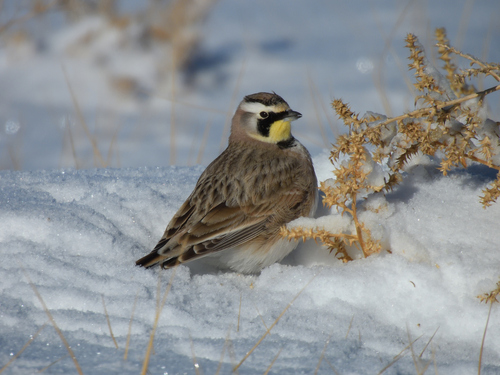
Shore Lark
Eurasian Skylark
In short
The Shore Lark (Eremophila alpestris) and the Eurasian Skylark (Alauda arvensis) can be distinguished by their structural differences and distinct plumage features. The Shore Lark has a more distinctive facial pattern with a black mask and yellow throat, while the Eurasian Skylark is more uniformly brown with a less pronounced facial pattern. Both species are ground-dwelling larks but differ in their preferred habitats and vocalizations.
Identification tips
- Look for the black mask and yellow throat on the Shore Lark, absent in the Eurasian Skylark. 2. Note the small black 'horns' on the Shore Lark's head, especially in males. 3. Observe the display flight of the Eurasian Skylark, which sings while ascending high into the sky. 4. Consider habitat: Shore Larks are more likely in barren, open areas, while Eurasian Skylarks prefer fields and grasslands.
Size
Both species are similar in size, but the Eurasian Skylark is generally slightly larger and more robust.
Plumage
The Shore Lark has a striking black and yellow facial pattern, with a black mask and yellow throat, and often shows small black 'horns' on the head. In contrast, the Eurasian Skylark is more uniformly streaked brown with a less distinct facial pattern and lacks the black mask and yellow throat.
Behaviour
Both species are ground-dwelling and often seen foraging on open ground. The Eurasian Skylark is known for its display flights, singing high in the sky, while the Shore Lark tends to stay closer to the ground.
Habitat
The Shore Lark prefers open, often barren habitats such as tundra and coastal areas, while the Eurasian Skylark is more commonly found in agricultural fields, grasslands, and meadows.
Voice
The Eurasian Skylark is famous for its continuous, melodious song delivered in flight, whereas the Shore Lark's song is less complex and often given from the ground or a low perch.