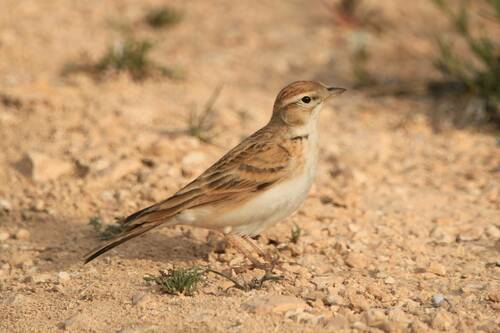
Shore Lark vs Greater Short-toed Lark
Eremophila alpestris versus Calandrella brachydactyla
Play a quiz with Shore Lark and Greater Short-toed Lark

Shore Lark
Greater Short-toed Lark
In short
The Shore Lark (Eremophila alpestris) and the Greater Short-toed Lark (Calandrella brachydactyla) can be distinguished by their facial markings and bill shape. Shore Larks have a distinctive black mask and yellow face, while Greater Short-toed Larks have a more uniform face with a less prominent supercilium. Bill shape is another key difference, with the Shore Lark having a slightly thicker bill.
Identification tips
- Look for the black mask and yellow face of the Shore Lark, especially in males. 2. Note the bill shape: Shore Larks have a slightly thicker bill compared to the slender bill of Greater Short-toed Larks. 3. Observe the habitat: Shore Larks are often in open, barren areas, while Greater Short-toed Larks are found in a variety of open habitats. 4. Listen for the song: Shore Larks have a musical song, whereas Greater Short-toed Larks have a repetitive song.
Size
Both species are similar in size, but the Shore Lark may appear slightly bulkier.
Plumage
Shore Larks have a striking black mask and yellow face, especially in males, with a black breast band. Greater Short-toed Larks have a more uniform brownish face and lack the distinct facial markings of the Shore Lark.
Behaviour
Both species forage on the ground, but Shore Larks are more likely to be seen in open, barren areas, while Greater Short-toed Larks can be found in a variety of open habitats.
Habitat
Shore Larks prefer open, often barren landscapes such as tundra or coastal areas, while Greater Short-toed Larks inhabit dry, open areas including steppes and semi-deserts.
Voice
Shore Larks have a musical, tinkling song, while Greater Short-toed Larks produce a more mechanical, repetitive song.