Short-billed Canastero vs Olive Spinetail
Asthenes baeri versus Cranioleuca obsoleta
Play a quiz with Short-billed Canastero and Olive Spinetail
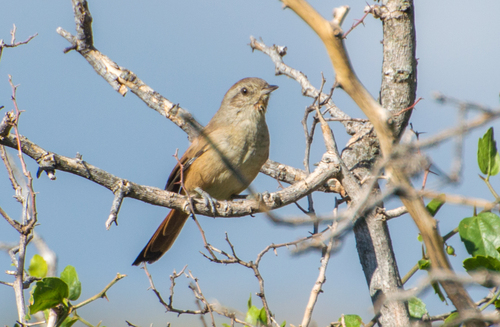
Short-billed Canastero
Olive Spinetail
In short
The Short-billed Canastero and Olive Spinetail are both small, brownish birds from the Furnariidae family, but they can be distinguished by their bill shape and habitat preferences. The Short-billed Canastero has a notably shorter and stubbier bill compared to the Olive Spinetail, which has a more slender bill.
Identification tips
1. Bill Shape: Look for the shorter, stubbier bill of the Short-billed Canastero compared to the slender bill of the Olive Spinetail. 2. Habitat: Consider the habitat; thorn forests suggest Short-billed Canastero, while humid forests suggest Olive Spinetail. 3. Plumage Tone: Note any olive tinge in the plumage for Olive Spinetail, though this can be subtle. 4. Behavior: Observe the foraging height; Olive Spinetail may be higher in trees.
Size
Both species are similar in size, typical of small passerines, but the Short-billed Canastero may appear slightly more compact due to its shorter bill.
Plumage
The Short-billed Canastero has a more uniform brown plumage, while the Olive Spinetail may show a slight olive tinge. Both species have subtle plumage differences that can be challenging to discern in the field.
Behaviour
Both species are active and tend to forage in dense vegetation, but the Olive Spinetail may be slightly more arboreal, often seen higher in the trees.
Habitat
The Short-billed Canastero prefers scrubby dry forests and thorn forests, while the Olive Spinetail is more likely found in humid forests and edge habitats.
Voice
Vocalizations are not well-documented in the sources, but both species likely have distinctive calls typical of the Furnariidae family.