Short-eared Owl vs Tengmalm's Owl
Asio flammeus versus Aegolius funereus
Play a quiz with Short-eared Owl and Tengmalm's Owl

Short-eared Owl
Tengmalm's Owl
In short
Short-eared Owls and Tengmalm's Owls can be distinguished primarily by their size and habitat preferences. Short-eared Owls are larger and often found in open habitats, while Tengmalm's Owls are smaller and prefer dense forests. Both species have distinct facial discs, but their vocalizations differ significantly.
Identification tips
- Size and Habitat: Look for the larger size and open habitat of the Short-eared Owl versus the smaller size and forest habitat of the Tengmalm's Owl. 2. Facial Disc: Note the pale facial disc with yellow eyes in Short-eared Owls compared to the white 'X' pattern in Tengmalm's Owls. 3. Vocalizations: Listen for the Tengmalm's Owl's repetitive call, which is absent in the typically silent Short-eared Owl.
Size
Short-eared Owls are larger, with a wingspan of about 85-110 cm, compared to the smaller Tengmalm's Owl, which has a wingspan of around 54-62 cm.
Plumage
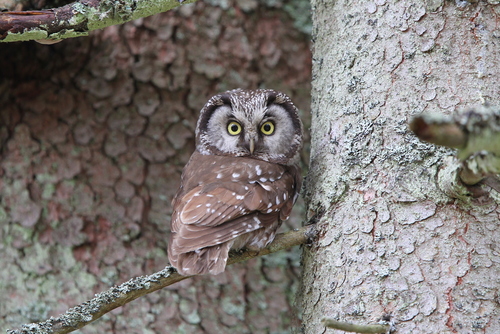
Short-eared Owls have mottled brown plumage with buffy streaks and prominent yellow eyes set in a pale facial disc. Tengmalm's Owls have a more uniform brown plumage with white spots and a distinct white 'X' pattern on their facial disc.
Behaviour
Short-eared Owls are often seen flying low over open fields during the day, while Tengmalm's Owls are more nocturnal and secretive, typically roosting in dense coniferous forests.
Habitat
Short-eared Owls prefer open habitats such as grasslands, marshes, and tundra. Tengmalm's Owls are found in dense boreal and montane forests, often in areas with abundant tree cover.
Voice
Short-eared Owls are generally silent but can emit a series of barks or hoots during the breeding season. Tengmalm's Owls have a distinct, repetitive 'poo-poo-poo' call, especially during the breeding season.