
Short-tailed Hawk vs Zone-tailed Hawk
Buteo brachyurus versus Buteo albonotatus
Play a quiz with Short-tailed Hawk and Zone-tailed Hawk
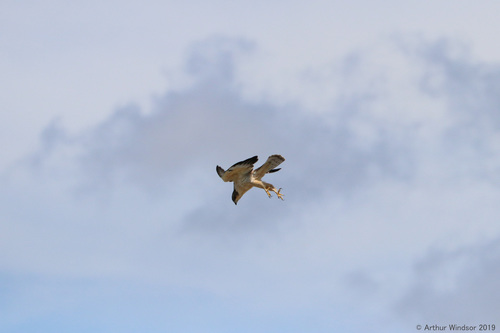 Short-tailed Hawk
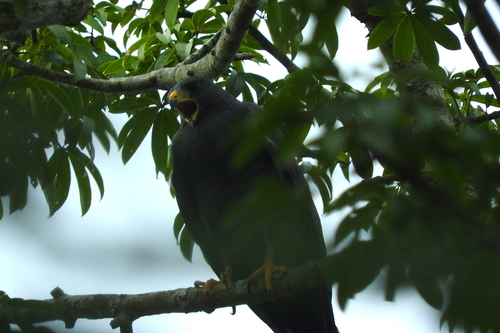 Zone-tailed Hawk
In short
The most reliable field mark to separate Short-tailed Hawk from Zone-tailed Hawk is the tail and wing pattern in flight: Zone-tailed Hawk shows multiple pale bands ('zones') across the tail and silvery barred flight feathers, while Short-tailed Hawk lacks these bold tail bands and has a shorter, less banded tail. Immature Zone-tailed Hawks also show small white spots on the breast and a broad dark tail tip, which Short-tailed Hawks do not. Structurally, Zone-tailed Hawk is longer-winged and longer-tailed, with a more vulture-like silhouette and flight style, while Short-tailed Hawk is compact and often appears with a shorter tail and wings. Both can be dark overall, but the patterning and proportions are key in the field.
Identification tips
- Tail pattern in flight (all ages): Zone-tailed Hawk shows 3–4 pale bands across the tail, with the second from the tip being broad and obvious; Short-tailed Hawk lacks these, with a shorter, less distinctly banded tail.
- Wing pattern (adults): Zone-tailed Hawk has silvery, barred flight feathers contrasting with blackish coverts; Short-tailed Hawk's wings are more uniform and lack the strong barring.
- Immature breast spotting: Immature Zone-tailed Hawks have small white spots on the breast; Short-tailed Hawks do not.
- Tail tip in immatures: Immature Zone-tailed Hawks show a broad dark tip to the tail; Short-tailed Hawk immatures do not.
- Flight silhouette: Zone-tailed Hawk is long-winged and long-tailed, with a vulture-like, slender appearance; Short-tailed Hawk is compact, with a shorter tail and wings.
- Soaring style: Zone-tailed Hawk soars with wings in a dihedral and rocks side to side, often among vultures; Short-tailed Hawk soars more like a typical Buteo and may kite into the wind.
- Perched posture: Zone-tailed Hawk often perches in open, visible spots; Short-tailed Hawk is secretive, often hidden in canopy or with only the head visible.
- Facial and leg color (adults): Zone-tailed Hawk shows yellow cere and legs, and sometimes a touch of white on the face; Short-tailed Hawk is less contrasting in these areas.
- Overall darkness: Both can appear very dark, especially in the dark morph of Short-tailed Hawk, but Zone-tailed Hawk is more likely to show contrasting pale bands and silvery wings.
- Association with vultures: If seen soaring with Turkey Vultures, suspect Zone-tailed Hawk; Short-tailed Hawk does not typically join vulture kettles.
- Habitat context: In open, dry, or semi-arid regions, Zone-tailed Hawk is more likely; in wooded edges or subtropical forests, Short-tailed Hawk is more likely.
- Size impression: Zone-tailed Hawk is larger and more robust, especially in the field when compared side by side, but beware overlap and distance effects.
- Sex differences: Only Zone-tailed Hawk shows significant sexual size dimorphism, with females being much heavier.
- Vocalizations: Not diagnostic with current information.
- Pitfalls: Dark morph Short-tailed Hawk can look superficially similar to Zone-tailed Hawk, but always check for tail bands and wing barring in flight, and use structure and behavior as secondary checks.
Size
Zone-tailed Hawk is the larger and more robust species, with a body mass averaging around 762.5 g (and up to 1080 g in females), a length of 46–56 cm, and a wingspan of 117–140 cm. Short-tailed Hawk is smaller and more compact, but precise mass data is lacking. In the field, Zone-tailed Hawks appear more slender and long-winged, especially compared to the stubby, short-tailed look of Short-tailed Hawk. Sexes are similar in both, but female Zone-tailed Hawks are notably heavier than males.
Plumage
- Immature/juvenile birds: Zone-tailed Hawk immatures have small white spots on the breast and a tail with narrow gray and black bands plus a broad dark tip. Short-tailed Hawk immatures do not show these marks; their tails are shorter and lack the bold, multiple pale bands of Zone-tailed Hawk.
- Adults in flight: Zone-tailed Hawk adults are mostly blackish with barred, silvery flight feathers and a tail with three or four pale bands (the second from the tip is especially broad and conspicuous). Short-tailed Hawk adults (in dark morph) are also dark overall but lack the strong tail banding and have a shorter tail; their underwings do not show the same silvery barring.
- Perched birds: Both can appear dark, but Zone-tailed Hawk may show a touch of white on the face and yellow cere/legs, while Short-tailed Hawk is less likely to show such contrast. The overall impression is that Zone-tailed Hawk is more patterned (especially in the tail and wings), while Short-tailed Hawk is more uniform.
Behaviour
Zone-tailed Hawk is famous for its mimicry of Turkey Vulture: it soars with wings held in a dihedral (V-shape), rocks side to side, and often mingles with vultures. This behavior is rare in Short-tailed Hawk, which also soars but tends to kite (hover facing into the wind with stationary wings) and is less likely to join vulture kettles. Short-tailed Hawk is more often seen hunting from a high soar or, rarely, from a perch, and is generally more secretive when perched, often hidden in canopy.
Habitat
Both species occur in warm parts of the Americas, but Zone-tailed Hawk favors dry, open, or semi-open habitats and is often seen in areas where Turkey Vultures are common. Short-tailed Hawk is more associated with wooded edges, forest borders, and subtropical/tropical habitats, and is less likely to be seen in open, arid regions. In Florida and Arizona, Short-tailed Hawk is local and rare, while Zone-tailed Hawk is more widespread in suitable dry habitats.