Birdr

Short-tailed Swift vs Fork-tailed Palm Swift

Chaetura brachyura versus Tachornis squamata

Play a quiz with Short-tailed Swift and Fork-tailed Palm Swift
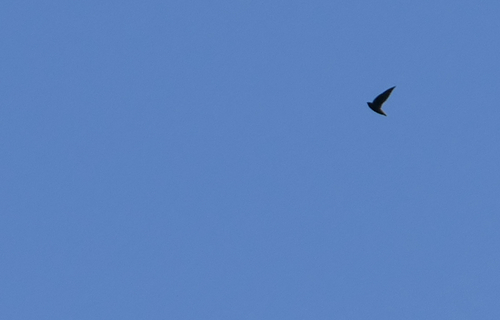
Short-tailed Swift (Chaetura brachyura) Short-tailed Swift
Fork-tailed Palm Swift (Tachornis squamata) Fork-tailed Palm Swift

Media

Loading…

In short

The Short-tailed Swift and Fork-tailed Palm Swift can be distinguished primarily by their tail shapes and flight patterns. The Short-tailed Swift has a squared-off tail, while the Fork-tailed Palm Swift features a deeply forked tail. Both species are similar in size and coloration, but their preferred habitats and nesting behaviors offer additional clues.

Identification tips

  1. Look for the tail shape: Short-tailed Swift has a squared tail, Fork-tailed Palm Swift has a deeply forked tail. 2. Observe flight behavior: Short-tailed Swift flies directly, Fork-tailed Palm Swift is more fluttery. 3. Consider habitat: Fork-tailed Palm Swift is often near palms, especially when nesting.

Size

Both species are similar in size, typical of small swifts.

Plumage

Both have dark plumage with little variation, making tail shape a more reliable field mark.

Behaviour

Short-tailed Swifts often fly in rapid, direct flight patterns, while Fork-tailed Palm Swifts exhibit more fluttery, erratic flight with quick turns.

Habitat

Short-tailed Swifts are more generalist in habitat preference, while Fork-tailed Palm Swifts are closely associated with palm groves, where they nest on palm leaves.

Voice

Vocalizations are not a primary distinguishing feature; both species have high-pitched calls typical of swifts.

Submit a better description

Use the same sections as the comparison. Your text is published immediately.

The Short-tailed Swift and Fork-tailed Palm Swift can be distinguished primarily by their tail shapes and flight patterns. The Short-tailed Swift has a squared-off tail, while the Fork-tailed Palm Swift features a deeply forked tail. Both species are similar in size and coloration, but their preferred habitats and nesting behaviors offer additional clues.

  1. Look for the tail shape: Short-tailed Swift has a squared tail, Fork-tailed Palm Swift has a deeply forked tail. 2. Observe flight behavior: Short-tailed Swift flies directly, Fork-tailed Palm Swift is more fluttery. 3. Consider habitat: Fork-tailed Palm Swift is often near palms, especially when nesting.

Both species are similar in size, typical of small swifts.

Both have dark plumage with little variation, making tail shape a more reliable field mark.

Short-tailed Swifts often fly in rapid, direct flight patterns, while Fork-tailed Palm Swifts exhibit more fluttery, erratic flight with quick turns.

Short-tailed Swifts are more generalist in habitat preference, while Fork-tailed Palm Swifts are closely associated with palm groves, where they nest on palm leaves.

Vocalizations are not a primary distinguishing feature; both species have high-pitched calls typical of swifts.

Discard your changes?

You have unsaved edits. If you leave now, those changes will be lost.

Short-tailed Swift · Fork-tailed Palm Swift · My Tricky Birds