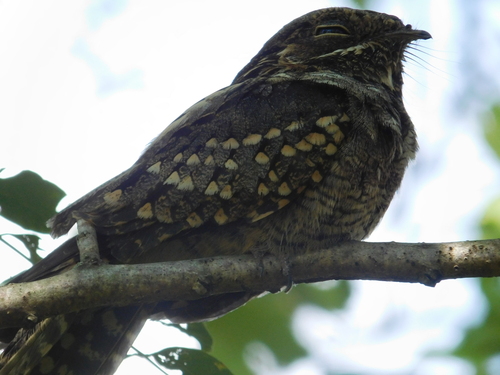
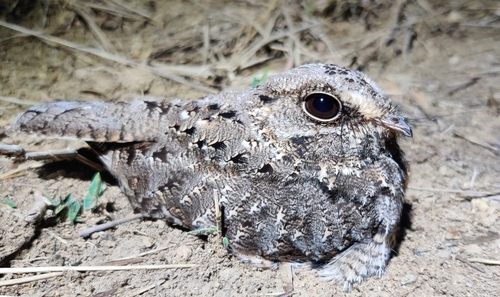
Sickle-winged Nightjar vs Little Nightjar
Eleothreptus anomalus versus Setopagis parvula
Play a quiz with Sickle-winged Nightjar and Little Nightjar
Sickle-winged Nightjar
Little Nightjar
In short
The Sickle-winged Nightjar and Little Nightjar can be distinguished by their wing shape and plumage details. The Sickle-winged Nightjar has distinctive sickle-shaped wings, while the Little Nightjar features a broad tawny collar and white patches on the wings and tail.
Identification tips
- Look for the sickle-shaped wings of the Sickle-winged Nightjar. 2. Note the broad tawny collar and white wing and tail patches on the Little Nightjar. 3. Consider habitat: grasslands for Sickle-winged, open woodlands for Little Nightjar.
Size
Both species are similar in size, typical of nightjars, but the Sickle-winged Nightjar may appear slightly larger due to its wing shape.
Plumage
The Sickle-winged Nightjar has less distinctive plumage compared to the Little Nightjar, which is grayish brown with a broad tawny collar, a white throat patch, and white tips on the tail feathers.
Behaviour
Both species exhibit typical nightjar behavior, being crepuscular and nocturnal, but specific behavioral differences are not well-documented.
Habitat
The Sickle-winged Nightjar prefers grassland and marshy edges, while the Little Nightjar is found in open woodland across central and eastern South America.
Voice
Vocalizations are not detailed in the sources, so differences in calls are uncertain.