Birdr

Singing Bushlark vs Rufous-capped Lark

Mirafra javanica versus Calandrella eremica

Play a quiz with Singing Bushlark and Rufous-capped Lark
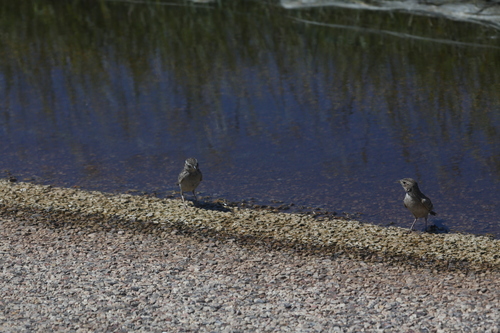
Singing Bushlark (Mirafra javanica) Singing Bushlark
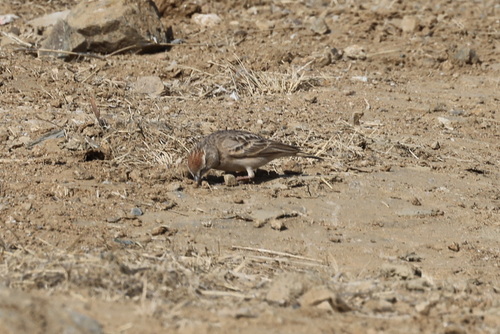
Rufous-capped Lark (Calandrella eremica) Rufous-capped Lark

Media

Loading…

In short

The Singing Bushlark and Rufous-capped Lark are both small, ground-dwelling larks, but they can be distinguished by their head markings and habitat preferences. The Singing Bushlark often shows a more streaked appearance with a less distinct head pattern, while the Rufous-capped Lark has a notable rufous crown and a more defined facial pattern.

Identification tips

  1. Look for the rufous crown on the Rufous-capped Lark, which is absent in the Singing Bushlark. 2. Note the streaked plumage of the Singing Bushlark, which can vary in intensity. 3. Consider the habitat: Rufous-capped Larks are more likely in arid, open areas, while Singing Bushlarks prefer grasslands. 4. When in doubt, observe the head pattern; Rufous-capped Larks have a more defined facial pattern.

Size

Both species are similar in size, typical of small larks.

Plumage

The Singing Bushlark tends to have a streaked appearance with variable plumage ranging from pale to dark forms. In contrast, the Rufous-capped Lark is characterized by its distinctive rufous crown, which is a key feature for identification, and a more defined facial pattern.

Behaviour

Both species exhibit typical lark behavior, such as ground foraging and short flights. Specific behavioral differences are not well-documented.

Habitat

Singing Bushlarks are often found in open grasslands and agricultural areas, while Rufous-capped Larks prefer more arid, open habitats with sparse vegetation.

Voice

Vocalizations are not well-documented for field differentiation. Singing Bushlarks are known for their melodious song, but specific differences in calls are not detailed.

Submit a better description

Use the same sections as the comparison. Your text is published immediately.

The Singing Bushlark and Rufous-capped Lark are both small, ground-dwelling larks, but they can be distinguished by their head markings and habitat preferences. The Singing Bushlark often shows a more streaked appearance with a less distinct head pattern, while the Rufous-capped Lark has a notable rufous crown and a more defined facial pattern.

  1. Look for the rufous crown on the Rufous-capped Lark, which is absent in the Singing Bushlark. 2. Note the streaked plumage of the Singing Bushlark, which can vary in intensity. 3. Consider the habitat: Rufous-capped Larks are more likely in arid, open areas, while Singing Bushlarks prefer grasslands. 4. When in doubt, observe the head pattern; Rufous-capped Larks have a more defined facial pattern.

Both species are similar in size, typical of small larks.

The Singing Bushlark tends to have a streaked appearance with variable plumage ranging from pale to dark forms. In contrast, the Rufous-capped Lark is characterized by its distinctive rufous crown, which is a key feature for identification, and a more defined facial pattern.

Both species exhibit typical lark behavior, such as ground foraging and short flights. Specific behavioral differences are not well-documented.

Singing Bushlarks are often found in open grasslands and agricultural areas, while Rufous-capped Larks prefer more arid, open habitats with sparse vegetation.

Vocalizations are not well-documented for field differentiation. Singing Bushlarks are known for their melodious song, but specific differences in calls are not detailed.

Discard your changes?

You have unsaved edits. If you leave now, those changes will be lost.

Singing Bushlark · Rufous-capped Lark · My Tricky Birds