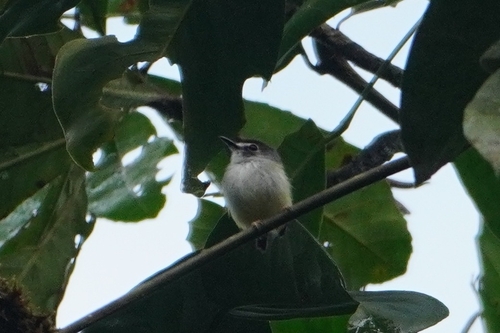
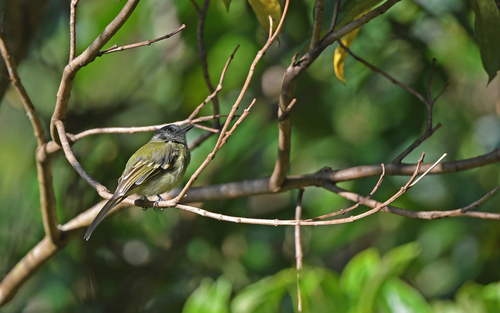
Slaty-capped Flycatcher vs Black-capped Pygmy-Tyrant
Leptopogon superciliaris versus Myiornis atricapillus
Play a quiz with Slaty-capped Flycatcher and Black-capped Pygmy-Tyrant
Slaty-capped Flycatcher
Black-capped Pygmy-Tyrant
In short
The Slaty-capped Flycatcher and Black-capped Pygmy-Tyrant can be distinguished by size and head markings. The Slaty-capped Flycatcher is larger and has a slaty-colored cap, while the Black-capped Pygmy-Tyrant is notably smaller with a distinctive black crown in males.
Identification tips
- Size: Note the size difference; the Black-capped Pygmy-Tyrant is significantly smaller. 2. Head Markings: Look for the slaty cap on the Slaty-capped Flycatcher and the black crown on male Black-capped Pygmy-Tyrants. 3. Behavior: Observe foraging behavior; the Pygmy-Tyrant may seem more frenetic. 4. Habitat: Consider elevation and forest type; the Slaty-capped Flycatcher may be found at higher elevations.
Size
The Slaty-capped Flycatcher is larger than the diminutive Black-capped Pygmy-Tyrant, which is one of the smallest passerines.
Plumage
The Slaty-capped Flycatcher has a slaty-colored cap and a more uniform appearance. In contrast, the Black-capped Pygmy-Tyrant male has a distinct black crown, while females have a gray head.
Behaviour
Both species are active foragers, but the Black-capped Pygmy-Tyrant may appear more restless due to its smaller size and rapid movements.
Habitat
Both species inhabit forested areas, but the Slaty-capped Flycatcher is often found at higher elevations compared to the Black-capped Pygmy-Tyrant.
Voice
The vocalizations of these species are not well-documented here, but they are known to differ. Observers should listen for differences in calls when possible.
Slaty-capped Flycatcher · Black-capped Pygmy-Tyrant · My Tricky Birds