
Slavonian Grebe vs Black-necked Grebe
Podiceps auritus versus Podiceps nigricollis
Play a quiz with Slavonian Grebe and Black-necked Grebe
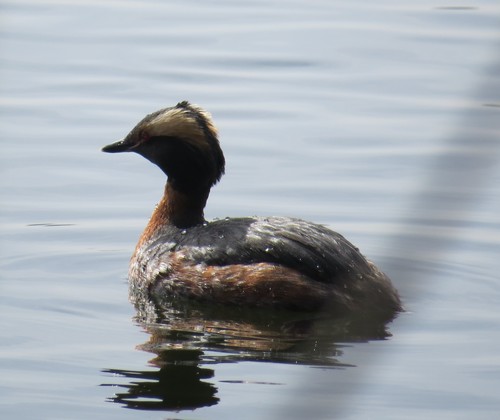 Slavonian Grebe
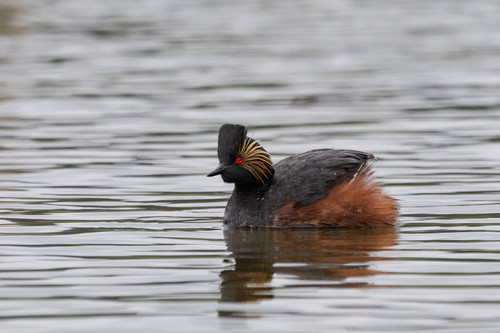 Black-necked Grebe
In short
The most reliable field mark between Slavonian (Horned) Grebe and Black-necked (Eared) Grebe is the color and shape of the head plumes in breeding plumage: Slavonian Grebe shows bright orange 'horns' that stand up sharply, while Black-necked Grebe has a fan of ochre feathers spreading behind the eye and over the ear coverts. In non-breeding and juvenile plumages, separation is trickier, but Slavonian Grebe has a straighter, more sharply defined border between the black crown and white cheeks, whereas Black-necked Grebe's dark cap extends diffusely below the eye and onto the ear-coverts, with white ovals behind the ear. Structure also helps: Slavonian Grebe has a straight, pointed bill with a pale tip, while Black-necked Grebe's bill is thinner, slightly upturned, and all dark. Both species are similar in size, but Slavonian is typically a bit heavier. Flight and wing pattern differences are subtle in the sources, so focus on head and face pattern, bill shape, and breeding head plumes for confident separation.
Identification tips
- Breeding head plumes: Slavonian Grebe shows bright orange, sharply pointed 'horns' above the eye; Black-necked Grebe has a fan of ochre feathers spreading behind the eye and over the ear coverts. Only use this in full breeding plumage.
- Face pattern (non-breeding/juvenile): Slavonian Grebe has a crisp, straight border between the black crown and white cheeks, running directly behind the eye. Black-necked Grebe's dark crown is more diffuse, extends below the eye, and there are white ovals behind the ear-coverts.
- Bill shape and color: Slavonian Grebe's bill is straight, pointed, and has a pale tip (especially obvious at close range); Black-necked Grebe's bill is thin, slightly upturned, and all dark. This works year-round.
- Neck color (breeding): Slavonian Grebe has a chestnut neck and upper chest; Black-necked Grebe's neck is black, sometimes with a brown tinge.
- Flank color (breeding): Slavonian Grebe's flanks are chestnut; Black-necked Grebe's are maroon-chestnut to tawny rufous, but this is subtle and variable.
- Cheek and nape color (non-breeding): Slavonian Grebe's cheeks and neck are white; Black-necked Grebe's neck is grey to brownish-grey with variable white, and the dark cap reaches lower on the face.
- Juvenile marks: Juvenile Slavonian Grebe is duller than adult non-breeding, with a less distinct cheek/crown border and a paler bill. Juvenile Black-necked Grebe is browner above, with buffy tinges on the head and whitish marks behind the eye.
- Eye color: Both have red eyes, but Black-necked Grebe's is brighter with a colored orbital ring, sometimes visible at close range.
- Size: Slavonian Grebe is slightly larger and heavier, but this is rarely useful unless birds are side by side.
- Flight and wing pattern: No strong, age-specific upperwing differences are described in the sources; both show white in the secondaries, but this is not a reliable separator.
- Bill jizz at distance: In profile, Slavonian Grebe's bill looks straight and dagger-like; Black-necked Grebe's appears thinner and slightly upturned.
- Winter context: In mixed flocks, look for the straight, clear cheek/crown border of Slavonian Grebe versus the diffuse, lower-reaching dark cap and white ovals of Black-necked Grebe.
- Habitat: Both overlap extensively, but large dense breeding colonies favor Black-necked Grebe; solitary or loosely colonial birds in vegetated lakes may be Slavonian.
- Sex differences: Both species are sexually similar; do not use sex for field separation.
- Pitfalls: Beware that non-breeding and juvenile birds of both species can look very similar, especially at a distance or in poor light. Focus on face pattern and bill shape for the best chance of a correct ID.
Size
Both species are small grebes, but Slavonian Grebe is generally heavier (average body mass about 450g [wikidata]) compared to Black-necked Grebe (range 215–450g [wikipedia]). Slavonian Grebe is slightly longer (31–38 cm) and has a broader wingspan (55–74 cm) than Black-necked Grebe (28–34 cm, wingspan 52–60 cm). In the field, size difference is subtle and rarely diagnostic unless seen side by side.
Plumage
Juvenile and non-breeding birds are the main pitfall. Juvenile Slavonian Grebe resembles a duller non-breeding adult, with a less distinct line between the black crown and white cheeks, and a paler bill. Juvenile Black-necked Grebe is also similar to its non-breeding adult, but the dark areas are browner, and the lores and sides of the head may show buff or tawny tinge, with whitish marks behind the eye. In non-breeding plumage, Slavonian Grebe has a crisp, straight border between the black crown and white cheeks, while Black-necked Grebe's dark cap is more diffuse and reaches below the eye, with white ovals behind the ear-coverts. In breeding plumage, Slavonian Grebe has bright orange, erect 'horns' and a chestnut neck and flanks, while Black-necked Grebe shows a fan of ochre feathers behind the eye, a black neck, and maroon-chestnut flanks. Both have red eyes, but Black-necked Grebe's is brighter with a colored orbital ring. The bill of Slavonian Grebe is straight with a pale tip; Black-necked Grebe's is thin, slightly upturned, and all dark.
Behaviour
Both species are diving waterbirds and show similar feeding and swimming behavior. Slavonian Grebe is noted for elaborate pair-bonding displays involving upright postures and weed-carrying, but these are rarely seen outside the breeding season or at a distance. In flight, both show rapid wingbeats and a compact, neck-outstretched profile typical of grebes. Behavioral differences are not usually diagnostic in the field.
Habitat
Both species occur on freshwater lakes and ponds during breeding, and move to larger bodies of water or coastal areas in winter. Slavonian Grebe tends to nest solitarily or in loose colonies, often in more vegetated or secluded sites, while Black-necked Grebe can form larger colonies. However, habitat overlap is extensive, and context is rarely diagnostic unless one is in a large, dense breeding colony (favoring Black-necked).