Birdr

Smith's Longspur vs Rufous-crowned Sparrow

Calcarius pictus versus Aimophila ruficeps

Play a quiz with Smith's Longspur and Rufous-crowned Sparrow

Smith's Longspur (Calcarius pictus) Smith's Longspur
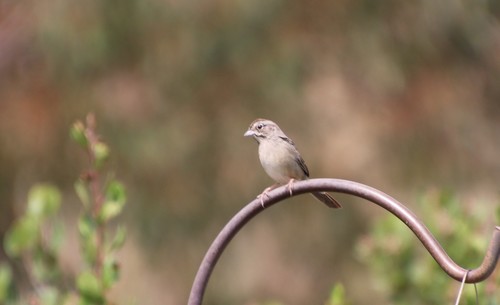
Rufous-crowned Sparrow (Aimophila ruficeps) Rufous-crowned Sparrow

Media

Loading…

In short

Smith's Longspur and Rufous-crowned Sparrow are distinct in both structure and habitat preferences. Smith's Longspur is a longspur with a more robust bill and prefers open grasslands, while the Rufous-crowned Sparrow is a sparrow with a smaller, more delicate bill and is found in arid, rocky areas. Their plumage and vocalizations also differ significantly.

Identification tips

Size

Smith's Longspur is slightly larger and more robust compared to the smaller, more delicate Rufous-crowned Sparrow.

Plumage

Smith's Longspur has a distinctive chestnut nape and streaked back, while the Rufous-crowned Sparrow features a rufous crown and a more uniform grayish-brown body. The sparrow's plumage is generally more muted and lacks the longspur's contrasting patterns.

Behaviour

Smith's Longspur exhibits a more promiscuous mating system with males assisting in feeding nestlings, whereas the Rufous-crowned Sparrow's behavior is less documented but typical of sparrows, often seen foraging on the ground.

Habitat

Smith's Longspur is typically found in open grasslands, especially during breeding, while the Rufous-crowned Sparrow prefers arid, rocky slopes and scrubby areas.

Voice

The vocalizations of these species differ, with Smith's Longspur having a more complex song compared to the simpler, repetitive song of the Rufous-crowned Sparrow.

Submit a better description

Use the same sections as the comparison. Your text is published immediately.

Smith's Longspur and Rufous-crowned Sparrow are distinct in both structure and habitat preferences. Smith's Longspur is a longspur with a more robust bill and prefers open grasslands, while the Rufous-crowned Sparrow is a sparrow with a smaller, more delicate bill and is found in arid, rocky areas. Their plumage and vocalizations also differ significantly.

  • Bill Shape: Smith's Longspur has a thicker bill compared to the Rufous-crowned Sparrow's more delicate bill.
  • Habitat: Look for Smith's Longspur in open grasslands and Rufous-crowned Sparrow in rocky, arid areas.
  • Plumage: Note the chestnut nape of Smith's Longspur versus the rufous crown of the Rufous-crowned Sparrow.
  • Vocalization: Listen for the more complex song of Smith's Longspur compared to the simpler song of the Rufous-crowned Sparrow.

Smith's Longspur is slightly larger and more robust compared to the smaller, more delicate Rufous-crowned Sparrow.

Smith's Longspur has a distinctive chestnut nape and streaked back, while the Rufous-crowned Sparrow features a rufous crown and a more uniform grayish-brown body. The sparrow's plumage is generally more muted and lacks the longspur's contrasting patterns.

Smith's Longspur exhibits a more promiscuous mating system with males assisting in feeding nestlings, whereas the Rufous-crowned Sparrow's behavior is less documented but typical of sparrows, often seen foraging on the ground.

Smith's Longspur is typically found in open grasslands, especially during breeding, while the Rufous-crowned Sparrow prefers arid, rocky slopes and scrubby areas.

The vocalizations of these species differ, with Smith's Longspur having a more complex song compared to the simpler, repetitive song of the Rufous-crowned Sparrow.

Discard your changes?

You have unsaved edits. If you leave now, those changes will be lost.

Smith's Longspur · Rufous-crowned Sparrow · My Tricky Birds