Snow Bunting vs McKay's Bunting
Plectrophenax nivalis versus Plectrophenax hyperboreus
Play a quiz with Snow Bunting and McKay's Bunting
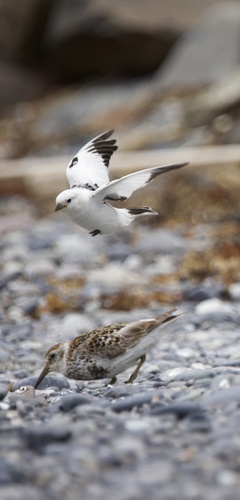
Snow Bunting
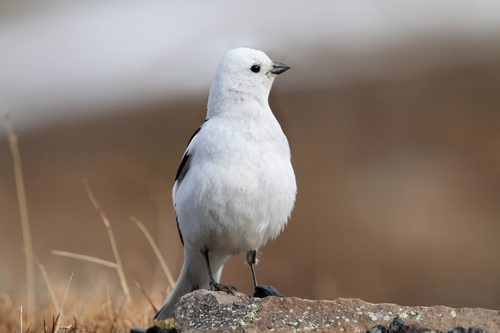
McKay's Bunting
In short
Snow Bunting and McKay's Bunting are closely related and can be challenging to differentiate. McKay's Bunting is the whitest of North American passerines, with a pure white body and black only on its wing-tips, scapulars, and tail. Snow Bunting has more extensive black on the wings and back, especially in non-breeding plumage.
Identification tips
- Plumage: Look for the pure white body of McKay's Bunting with minimal black markings compared to the more extensively marked Snow Bunting. 2. Location: Consider the geographical range; McKay's Bunting is found only on Hall and St. Matthew islands during breeding. 3. Season: In winter, Snow Buntings are more widespread and likely to be encountered outside of the Bering Sea islands.
Size
Both species are similar in size, typical of buntings, with no significant size difference.
Plumage
McKay's Bunting is predominantly white with limited black on the wing-tips, scapulars, and tail, making it appear whiter than the Snow Bunting. Snow Bunting has more black on the wings and back, especially noticeable in non-breeding plumage.
Behaviour
Both species exhibit similar behaviors typical of buntings, such as ground foraging and flocking, especially in winter.
Habitat
Snow Bunting is more widespread, found in Arctic tundra and open fields during winter, while McKay's Bunting is restricted to breeding on two small islands in the Bering Sea.
Voice
Vocalizations are similar between the two species, with no distinct differences noted in the available sources.