
Sociable Lapwing vs White-tailed Lapwing
Vanellus gregarius versus Vanellus leucurus
Play a quiz with Sociable Lapwing and White-tailed Lapwing
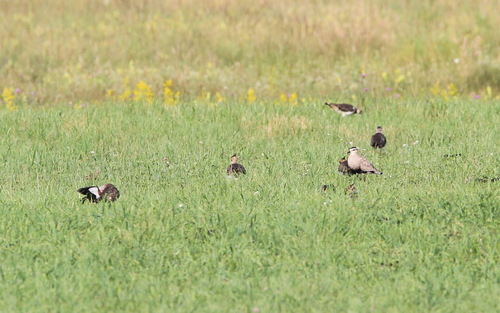 Sociable Lapwing
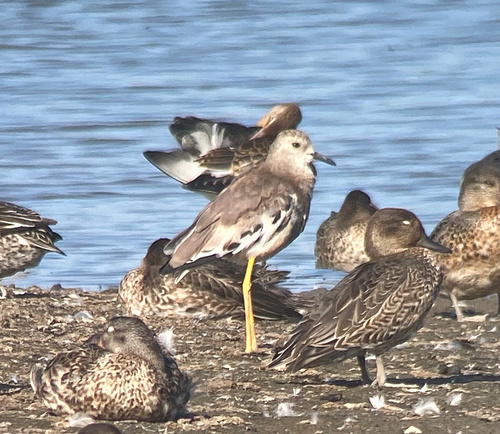 White-tailed Lapwing
In short
The most reliable field mark to separate Sociable Lapwing from White-tailed Lapwing is the head pattern: Sociable Lapwing (all ages) shows a bold black crown and eyestripe, both bordered with white, while White-tailed Lapwing has a plain, pale face with no strong markings. In flight, Sociable Lapwing has a white tail with a distinct black terminal band, whereas White-tailed Lapwing's tail is pure white (adults) or may show some brown in juveniles. Leg color is also key: Sociable Lapwing has dark grey to black legs, while White-tailed Lapwing's are bright yellow. Juvenile birds of both species have scaly backs, but only Sociable Lapwing juveniles ever show traces of the adult's head pattern. Use these marks in combination, especially on immatures or birds in flight.
Identification tips
- Head pattern (all ages): Sociable Lapwing always shows a bold black crown and eyestripe, both bordered with white, even in winter and on juveniles (though fainter). White-tailed Lapwing has a plain, pale face with no strong markings at any age.
- Tail pattern in flight: Sociable Lapwing has a white tail with a clear black terminal band (all ages). White-tailed Lapwing adults have a pure white tail; juveniles may show some brown but never a black band.
- Leg color: Sociable Lapwing has dark grey to black legs (all ages and seasons). White-tailed Lapwing has bright yellow legs, which are obvious at rest and in flight.
- Juvenile back pattern: Both species can show a scaly back, but only Sociable Lapwing juveniles show traces of the adult's head pattern. White-tailed Lapwing juveniles have a plain face and may show some brown in the tail.
- Breast and underparts: In breeding plumage, Sociable Lapwing develops a black lower breast fading to chestnut near the vent; White-tailed Lapwing never shows this, remaining plain.
- Cheek color: Sociable Lapwing breeding adults have ochre cheeks, contrasting with the rest of the face. White-tailed Lapwing's face is pale and uniform.
- Bill: Both have short, dark bills, but White-tailed Lapwing's is slightly longer and finer; this is not a strong field mark.
- Structure and jizz: White-tailed Lapwing is slimmer and longer-legged, often appearing more elegant and upright, especially when wading. Sociable Lapwing is more compact and terrestrial.
- Habitat: Sociable Lapwing prefers dry, open ground (steppes, fields); White-tailed Lapwing is usually in or near shallow water. If you see a lapwing wading, it's likely White-tailed.
- Flight style: Both species have strong, direct flight, but White-tailed Lapwing may appear more buoyant due to longer legs trailing behind.
- Voice: Sociable Lapwing's call is a harsh 'kereck'; White-tailed Lapwing gives a 'peewit' similar to Northern Lapwing. Use with caution, as calls can be missed or misheard.
- Season and range: Sociable Lapwing is highly migratory and rare; White-tailed Lapwing is more likely to be resident (in the south) or a regular migrant. Both can occur as vagrants, so do not rely solely on location.
- Pitfall: In poor light, leg color can be hard to judge; rely on head pattern and tail band if possible.
- Pitfall: Juvenile White-tailed Lapwing may show some brown in the tail, but never a black terminal band or bold head pattern.
- Pitfall: Both species can show scaly backs as juveniles; do not use this alone for ID—combine with head and tail pattern.
Size
Both species are medium-sized lapwings and are similar in overall length (Sociable Lapwing: 27–30 cm). The Sociable Lapwing is slightly heavier on average (body mass 226 g), but this difference is not obvious in the field. Structure is broadly similar, but White-tailed Lapwing is described as slimmer, longer-legged, and with a slightly longer bill. These differences are subtle and rarely diagnostic at a distance.
Plumage
Juvenile and immature birds: Both species have a scaly appearance to the back due to pale feather edges, but only Sociable Lapwing juveniles show even faint traces of the adult's bold head pattern (black crown and eyestripe with white borders). White-tailed Lapwing juveniles have a plain, pale face and may show some brown in the tail, but never develop a marked head pattern.
Adults in non-breeding (winter) plumage: Sociable Lapwing has a striking head pattern (black crown and eyestripe, both bordered with white), pale underparts, and a white tail with a black terminal band. White-tailed Lapwing is plainer: brown back and foreneck, pale face, grey breast, pure white tail, and yellow legs.
Breeding adults: Sociable Lapwing becomes more vivid, with greyish, glossy upperparts, ochre cheeks, stronger black crown and eyestripe, and a black lower breast fading to chestnut near the vent. White-tailed Lapwing remains much the same, with no strong head pattern or breast band.
In flight: Sociable Lapwing's white tail with a black terminal band contrasts with White-tailed Lapwing's pure white tail (adults). Both have distinctive brown, white, and black wings, but the tail pattern is a key separator.
Behaviour
Both species feed by picking insects and small prey from grassland or arable land, but White-tailed Lapwing is more likely to be seen wading in shallow water, often in a more upright, elegant posture due to its longer legs. Sociable Lapwing is more terrestrial, preferring drier steppes and fields, and is less likely to be found in water deeper than its tarsi.
Habitat
Sociable Lapwing breeds on open steppes, arid grasslands, and cultivated fields, avoiding wetlands. In migration and winter, it is often found in dry fields or short grassland, sometimes alongside Northern Lapwing. White-tailed Lapwing prefers wet habitats: inland marshes, shallow lakes, and muddy edges, and is the only lapwing in the region likely to be seen wading in water. Habitat overlap can occur on migration, but context can help: a lapwing in a marsh or shallow water is more likely to be White-tailed.
Voice
Sociable Lapwing gives a harsh 'kereck' call, while White-tailed Lapwing's breeding call is a 'peewit', similar to Northern Lapwing. Calls are not always diagnostic, but the 'kereck' of Sociable Lapwing is harsher and less musical than the 'peewit' of White-tailed.