
Birdr

Solitary Sandpiper vs Grey-tailed Tattler

Tringa solitaria versus Tringa brevipes

Play a quiz with Solitary Sandpiper and Grey-tailed Tattler
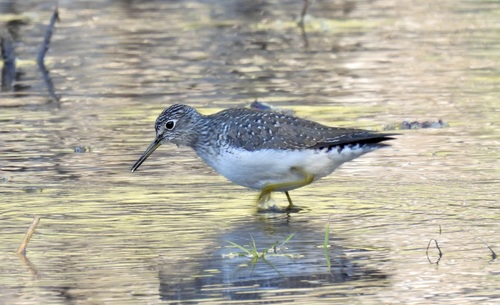
Solitary Sandpiper (Tringa solitaria) Solitary Sandpiper
Grey-tailed Tattler (Tringa brevipes) Grey-tailed Tattler

Media

Loading…

In short

The Solitary Sandpiper and Grey-tailed Tattler are similar in size and shape, both being medium-sized shorebirds with long legs and straight bills. The most reliable field mark is the Solitary Sandpiper's white eye-ring, which contrasts with the Grey-tailed Tattler's more prominent supercilium. Both species are part of the Tringa genus, but they differ in plumage and vocalizations.

Identification tips

  1. Look for the white eye-ring on the Solitary Sandpiper; the Grey-tailed Tattler has a more pronounced supercilium. 2. Observe behavior: Solitary Sandpipers often hold wings up after landing. 3. Consider habitat: Solitary Sandpipers are more likely in freshwater environments, while Grey-tailed Tattlers are coastal. 4. Listen for calls: Solitary Sandpipers have a high-pitched whistle, whereas Grey-tailed Tattlers have a trilling call.

Size

Both species are medium-sized shorebirds with similar body structures, making size an unreliable differentiator.

Plumage

The Solitary Sandpiper has a distinctive white eye-ring and darker, more uniformly colored upperparts. In contrast, the Grey-tailed Tattler features a more prominent supercilium and generally lighter grey upperparts.

Behaviour

The Solitary Sandpiper often holds its wings straight up after alighting, a behavior not typically observed in the Grey-tailed Tattler. Solitary Sandpipers are more likely to be seen alone or in small groups.

Habitat

Solitary Sandpipers breed in boreal forests and are often found in freshwater habitats during migration. Grey-tailed Tattlers prefer coastal areas and are more frequently seen along rocky shores and mudflats.

Voice

The Solitary Sandpiper's call is less documented, but it is known to have a distinctive, high-pitched whistle. The Grey-tailed Tattler has a more melodious, trilling call.

Submit a better description

Use the same sections as the comparison. Your text is published immediately.

The Solitary Sandpiper and Grey-tailed Tattler are similar in size and shape, both being medium-sized shorebirds with long legs and straight bills. The most reliable field mark is the Solitary Sandpiper's white eye-ring, which contrasts with the Grey-tailed Tattler's more prominent supercilium. Both species are part of the Tringa genus, but they differ in plumage and vocalizations.

  1. Look for the white eye-ring on the Solitary Sandpiper; the Grey-tailed Tattler has a more pronounced supercilium. 2. Observe behavior: Solitary Sandpipers often hold wings up after landing. 3. Consider habitat: Solitary Sandpipers are more likely in freshwater environments, while Grey-tailed Tattlers are coastal. 4. Listen for calls: Solitary Sandpipers have a high-pitched whistle, whereas Grey-tailed Tattlers have a trilling call.

Both species are medium-sized shorebirds with similar body structures, making size an unreliable differentiator.

The Solitary Sandpiper has a distinctive white eye-ring and darker, more uniformly colored upperparts. In contrast, the Grey-tailed Tattler features a more prominent supercilium and generally lighter grey upperparts.

The Solitary Sandpiper often holds its wings straight up after alighting, a behavior not typically observed in the Grey-tailed Tattler. Solitary Sandpipers are more likely to be seen alone or in small groups.

Solitary Sandpipers breed in boreal forests and are often found in freshwater habitats during migration. Grey-tailed Tattlers prefer coastal areas and are more frequently seen along rocky shores and mudflats.

The Solitary Sandpiper's call is less documented, but it is known to have a distinctive, high-pitched whistle. The Grey-tailed Tattler has a more melodious, trilling call.

Discard your changes?

You have unsaved edits. If you leave now, those changes will be lost.

Solitary Sandpiper · Grey-tailed Tattler · My Tricky Birds