Birdr

Solitary Sandpiper vs Wood Sandpiper

Tringa solitaria versus Tringa glareola

Play a quiz with Solitary Sandpiper and Wood Sandpiper
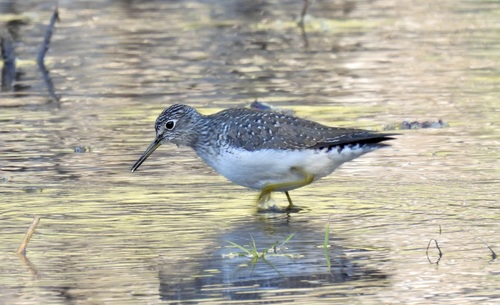
Solitary Sandpiper (Tringa solitaria) Solitary Sandpiper
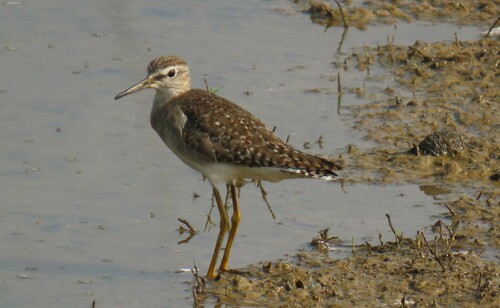
Wood Sandpiper (Tringa glareola) Wood Sandpiper

Media

Loading…

In short

The Solitary Sandpiper and Wood Sandpiper are similar in appearance but can be distinguished by their behavior and subtle plumage differences. The Solitary Sandpiper is more likely to be seen alone, while the Wood Sandpiper often associates with other waders.

Identification tips

1. Behavior: Look for solitary behavior in Solitary Sandpipers versus flocking in Wood Sandpipers. 2. Plumage: Note the darker back with white spots on Solitary Sandpipers compared to the lighter, speckled back of Wood Sandpipers. 3. Supercilium: Wood Sandpipers have a more prominent white supercilium. 4. Habitat: Solitary Sandpipers are more often in forested wetlands, while Wood Sandpipers prefer open marshes.

Size

Both species are similar in size, but the Solitary Sandpiper is slightly bulkier.

Plumage

The Solitary Sandpiper has a darker, more olive-brown back with distinct white spots, while the Wood Sandpiper has a lighter, more speckled appearance with a prominent white supercilium.

Behaviour

Solitary Sandpipers are often seen alone or in very small groups, whereas Wood Sandpipers are more social and can be found in larger flocks.

Habitat

Solitary Sandpipers prefer forested wetlands and are often found in more secluded areas, while Wood Sandpipers are more likely to be seen in open marshes and flooded fields.

Voice

The Solitary Sandpiper's call is a clear, whistled 'peet-weet', whereas the Wood Sandpiper's call is a softer, more rapid 'chiff-chiff'.

Submit a better description

Use the same sections as the comparison. Your text is published immediately.

The Solitary Sandpiper and Wood Sandpiper are similar in appearance but can be distinguished by their behavior and subtle plumage differences. The Solitary Sandpiper is more likely to be seen alone, while the Wood Sandpiper often associates with other waders.

1. Behavior: Look for solitary behavior in Solitary Sandpipers versus flocking in Wood Sandpipers. 2. Plumage: Note the darker back with white spots on Solitary Sandpipers compared to the lighter, speckled back of Wood Sandpipers. 3. Supercilium: Wood Sandpipers have a more prominent white supercilium. 4. Habitat: Solitary Sandpipers are more often in forested wetlands, while Wood Sandpipers prefer open marshes.

Both species are similar in size, but the Solitary Sandpiper is slightly bulkier.

The Solitary Sandpiper has a darker, more olive-brown back with distinct white spots, while the Wood Sandpiper has a lighter, more speckled appearance with a prominent white supercilium.

Solitary Sandpipers are often seen alone or in very small groups, whereas Wood Sandpipers are more social and can be found in larger flocks.

Solitary Sandpipers prefer forested wetlands and are often found in more secluded areas, while Wood Sandpipers are more likely to be seen in open marshes and flooded fields.

The Solitary Sandpiper's call is a clear, whistled 'peet-weet', whereas the Wood Sandpiper's call is a softer, more rapid 'chiff-chiff'.

Discard your changes?

You have unsaved edits. If you leave now, those changes will be lost.

Solitary Sandpiper · Wood Sandpiper · My Tricky Birds