
Song Thrush vs Eurasian Blackbird
Turdus philomelos versus Turdus merula
Play a quiz with Song Thrush and Eurasian Blackbird
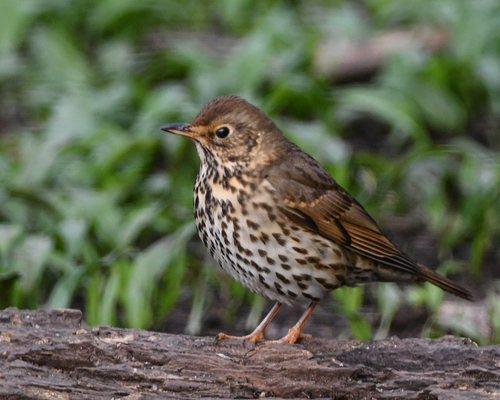 Song Thrush
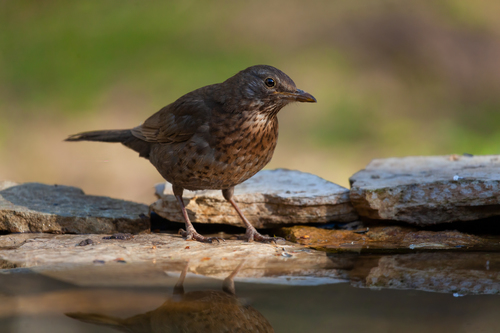 Eurasian Blackbird
In short
The most reliable field mark between Song Thrush and Eurasian Blackbird is overall plumage: Song Thrushes of all ages show brown upperparts with bold black spots on pale underparts, while adult male Blackbirds are entirely glossy black with a yellow bill and eye-ring, and females are plain brown without heavy spotting. Juvenile Song Thrushes have buff or orange streaks on the back and wing coverts, whereas juvenile Blackbirds are brown with pale spots above and a speckled breast. In flight, Song Thrushes show warm yellow underwings, contrasting with the Blackbird's uniformly dark wings. Structure and behavior also differ: Blackbirds are larger, longer-tailed, and often forage on lawns, while Song Thrushes are more compact and upright. Voice and song are distinctive if heard, but confusion is most likely with silent, immature birds.
Identification tips
- Plumage (adults): Song Thrushes always show bold black spots on pale underparts; Blackbirds never do, regardless of sex.
- Plumage (adult male Blackbird): All-black plumage with yellow bill and eye-ring is unique; Song Thrush is never black.
- Plumage (adult female Blackbird): Sooty-brown overall, with faint mottling, never with crisp spots. Song Thrush is browner above and heavily spotted below.
- Juvenile Song Thrush: Look for buff/orange streaks on back and wing coverts, and bold underpart spots. No Blackbird age shows this combination.
- Juvenile Blackbird: Brown above with pale spots, speckled breast, but not the neat, bold spotting of Song Thrush; lacks warm tones and streaks on the back.
- Underwing (flight): Song Thrush shows warm yellow underwings; Blackbird's underwing is dark and unmarked.
- Structure: Blackbird is longer, heavier, and has a longer tail; Song Thrush is more compact and upright, with a shorter tail.
- Bill color: Adult male Blackbird has a bright yellow-orange bill; Song Thrush's bill is yellowish but never as bright or orange. Female and juvenile Blackbirds have duller bills but still lack the Song Thrush's neat spotting.
- Eye-ring: Male Blackbird has a conspicuous yellow eye-ring; Song Thrush does not.
- Flight jizz: Song Thrush flies with rapid wingbeats and shows a compact, rounded shape; Blackbird's flight is more direct, with bursts of wingbeats and a longer, straighter tail.
- Song: Song Thrush repeats musical phrases; Blackbird sings continuous, mellow, fluty notes. Use only if singing.
- Alarm call: Song Thrush gives a sharp 'tsip' or strident 'chook-chook'; Blackbird's alarm is a harsh, chattering 'chook-chook.'
- Habitat: Blackbird is more likely in open lawns and urban parks; Song Thrush prefers shrubby, denser cover.
- Seasonal confusion: In winter, both may look duller, but the structural and underpart spotting differences remain reliable.
- Pitfalls: Female and juvenile Blackbirds are most often confused with Song Thrush, but always lack the neat, bold spotting and warm yellow underwing. Juvenile Song Thrushes never look uniform brown above.
Size
Song Thrush is noticeably smaller and lighter, with a typical mass around 72 g [wikidata], compared to the larger Eurasian Blackbird (80–125 g) [wikipedia]. Blackbird is also longer (23.5–29 cm vs. Song Thrush's 20–23.5 cm), with a proportionally longer tail and a bulkier, more elongated look. In direct comparison, Blackbird appears heavier-bodied and longer-tailed, while Song Thrush is more compact and upright.
Plumage
- Juvenile/First-year birds: Juvenile Song Thrushes resemble adults but have buff or orange streaks on the back and wing coverts, and always show bold dark spots on the underparts. Juvenile Blackbirds are brown above with pale spots (not streaks) and a speckled breast, lacking the Song Thrush's crisp spotting; their upperparts are more uniform, and the wing is brown, not black.
- Adults: Adult Song Thrushes are warm brown above with neat black spots on cream or buff underparts, paler on the belly. Their underwing is warm yellow (visible in flight). Adult male Blackbirds are glossy black overall, with a bright yellow-orange bill and eye-ring; females are sooty-brown, with a duller bill and weak mottling on the breast, but never show the Song Thrush's bold spotting. The Blackbird's underwing is not contrastingly colored.
- Flight views: Song Thrushes show a warm yellow underwing and a compact, rounded shape. Blackbirds in flight look longer-tailed and uniformly dark, lacking the Song Thrush's underwing contrast.
Behaviour
Blackbirds often forage openly on lawns and in gardens, moving with a run-and-pause gait, and are frequently seen alone or in pairs. They may defend territories aggressively, especially males with their bright bills. Song Thrushes are more likely to be seen in shrubbier areas, often hopping with a more upright posture and pausing to look for invertebrates. Both species can be secretive when alarmed, but Blackbirds are generally bolder in urban settings.
Habitat
Both species breed across the West Palearctic and are common in gardens, parks, and woodland edges. However, Blackbirds are more adaptable to urban environments and are often the default thrush in city parks and lawns. Song Thrushes prefer denser cover, hedgerows, and shrubby areas, and are less likely to be seen feeding in the open for long periods.
Voice
Song Thrushes have a loud, clear song of repeated musical phrases, often with mimicry, and a sharp 'tsip' call. Blackbirds sing more fluid, mellow, and fluty phrases without the repetition, and their alarm call is a harsh 'chook-chook.' If heard, the Song Thrush's repeated phrases are distinctive, while Blackbird's song is more continuous and less patterned.