
Sooty Grouse vs Sharp-tailed Grouse
Dendragapus fuliginosus versus Tympanuchus phasianellus
Play a quiz with Sooty Grouse and Sharp-tailed Grouse
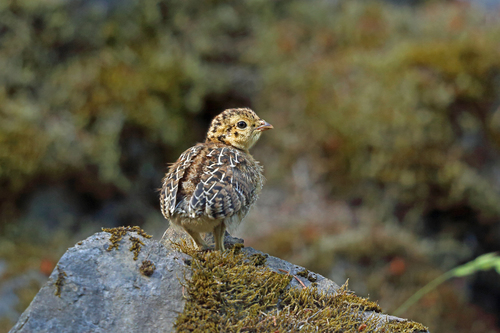 Sooty Grouse
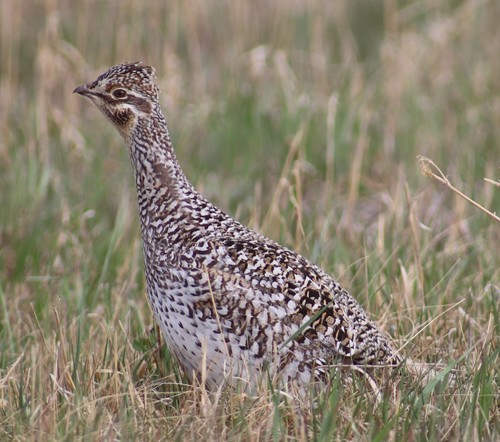 Sharp-tailed Grouse
In short
The most reliable field mark between Sooty Grouse and Sharp-tailed Grouse is the tail: Sooty Grouse shows a long, square tail with a light gray terminal band, while Sharp-tailed Grouse has a much shorter tail with sharply pointed central feathers. In flight or when perched, Sooty Grouse appears bulkier and darker overall, especially the male, whereas Sharp-tailed Grouse is paler, more patterned, and slimmer. Habitat is also a strong clue: Sooty Grouse is a forest bird of the Pacific Coast Ranges, while Sharp-tailed Grouse is a bird of open prairies and grasslands. Females of both species are mottled brown, but Sooty Grouse females are larger and less contrastingly marked. Immature and female birds can be confusing, but tail shape and overall jizz remain the best field clues.
Identification tips
- Tail shape is key: Sooty Grouse has a long, square tail with a pale gray terminal band; Sharp-tailed Grouse has a shorter tail with sharply pointed central feathers, giving a spiky look. This is visible in flight and when perched, and works for all ages and sexes.
- Overall size and build: Sooty Grouse is larger, bulkier, and more robust, especially the male. Sharp-tailed Grouse is slimmer and more medium-sized.
- Plumage tone: Adult male Sooty Grouse is very dark overall, especially on the body, while Sharp-tailed Grouse is paler and more patterned with barring and spotting.
- Female/immature confusion: Female Sooty Grouse is mottled brown but larger and less patterned than female Sharp-tailed Grouse, which is more finely barred and spotted.
- Display features: Male Sooty Grouse shows a yellow throat air sac and yellow wattle over the eye during display; Sharp-tailed Grouse males display by raising their pointed tails and stamping feet, with no colored throat sac.
- Habitat context: Sooty Grouse is found in forests, especially coniferous or mixed woods; Sharp-tailed Grouse is in open prairies, grasslands, or shrublands. Habitat is often the quickest clue.
- Group size and behavior: Sooty Grouse is usually solitary or in small groups; Sharp-tailed Grouse often forms larger groups, especially at leks.
- Flight profile: In flight, Sooty Grouse looks heavier and slower, with a broad, squared tail; Sharp-tailed Grouse is quicker, with a slim, pointed tail profile.
- Underpart pattern: Sooty Grouse females have less contrasting underparts, while Sharp-tailed Grouse females show more barring and spotting below.
- Bill and head: Sooty Grouse has a stouter bill and, in males, a more robust head; Sharp-tailed Grouse has a slimmer bill and head.
- Seasonal context: Both species can be seen year-round in their respective ranges, but displays (and thus display features) are most obvious in spring.
- Lekking behavior: Only Sharp-tailed Grouse forms large leks in open areas; Sooty Grouse males display alone or in loose groups in forest openings.
- Mistaken identity: Immature and female Sooty Grouse can be confused with other forest grouse, but the long, square tail remains a strong clue. Sharp-tailed Grouse's pointed tail is unique among North American grouse.
- No strong vocal differences in sources: If you hear display sounds, habitat and tail shape remain more reliable for separation.
- When in doubt: Focus on tail shape, habitat, and overall size/build as your best field clues, especially for birds in flight or at a distance.
Size
Sooty Grouse is generally larger and heavier than Sharp-tailed Grouse, with a length of 40–50 cm (16–20 in) and a mass range of 750–1,300 g (1.65–2.87 lb) [wikipedia], compared to the Sharp-tailed Grouse's average adult mass of 885 g [wikidata]. Sooty Grouse is bulkier and more robust, especially in males, while Sharp-tailed Grouse is slimmer and more medium-sized for a grouse.
Plumage
Age-specific upperwing or flight pattern differences are not detailed in the sources, so tail shape and overall coloration are the primary plumage cues. Adult male Sooty Grouse is mostly dark with a yellow throat air sac (visible during display) and a yellow wattle over the eye; females are mottled brown with dark brown and white on the underparts. The key field mark is the tail: Sooty Grouse has a long, square tail with a light gray terminal band, visible in flight and when perched. Sharp-tailed Grouse of all ages and sexes have a much shorter tail with sharply pointed central feathers, giving a spiky appearance, and their plumage is paler and more patterned, with extensive barring and spotting. Female Sooty Grouse is larger, less patterned, and darker below than female Sharp-tailed Grouse. In all ages, the Sooty Grouse's tail is diagnostic if seen well.
Behaviour
Sooty Grouse is typically found alone or in small groups, often perched in trees or on the ground in forested areas. Males display by inflating their yellow throat air sac and fanning their tails. Sharp-tailed Grouse is more likely to be seen in open grasslands, often in larger groups, especially at leks where males gather to display. Their displays involve raising their pointed tails, stamping feet, and showing off their pale, spiky tail feathers. In flight, Sooty Grouse appears heavier and slower, while Sharp-tailed Grouse is quicker and more agile, with a distinctive pointed tail profile.
Habitat
Habitat is a strong separator: Sooty Grouse is strictly a forest species, found in the Pacific Coast Ranges of North America, often in coniferous or mixed forests [wikipedia]. Sharp-tailed Grouse is a bird of open country, found in prairies, grasslands, and shrublands across Alaska, Canada, and parts of the western and midwestern US [wikipedia]. If you encounter a grouse in dense forest, it is almost certainly Sooty Grouse; in open prairie or grassland, Sharp-tailed Grouse is the expected species.