Birdr

Sooty Tern vs Black-fronted Tern

Onychoprion fuscatus versus Chlidonias albostriatus

Play a quiz with Sooty Tern and Black-fronted Tern
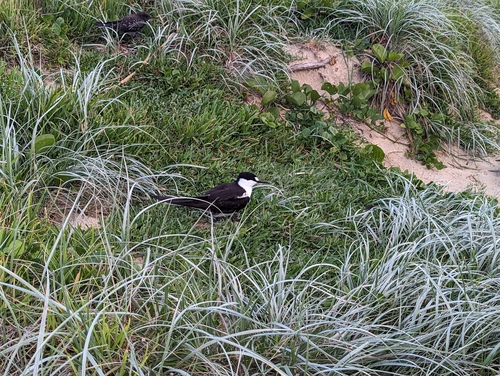
Sooty Tern (Onychoprion fuscatus) Sooty Tern
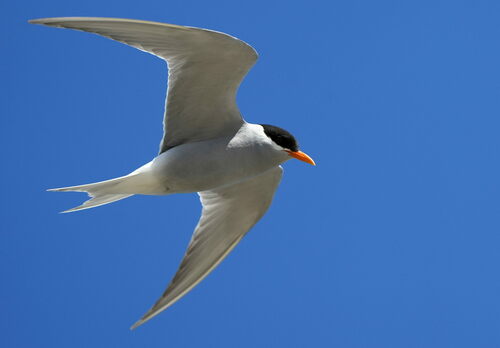
Black-fronted Tern (Chlidonias albostriatus) Black-fronted Tern

Media

Loading…

In short

Sooty Terns and Black-fronted Terns can be distinguished primarily by their plumage and habitat preferences. The Sooty Tern is typically found in tropical and subtropical oceanic regions, while the Black-fronted Tern is more associated with freshwater habitats in New Zealand. In terms of plumage, the Sooty Tern has a distinctive dark cap and white forehead, whereas the Black-fronted Tern has a black band across its eyes.

Identification tips

Look for the habitat: Sooty Terns are oceanic, while Black-fronted Terns are found in freshwater environments. Check the plumage: Sooty Terns have a dark cap and white forehead; Black-fronted Terns have a black eye band and gray body. Observe behavior: Sooty Terns are rarely seen resting on water, unlike Black-fronted Terns.

Plumage

The Sooty Tern features a dark cap with a contrasting white forehead and underparts, while the Black-fronted Tern has a black band across its eyes and a more uniformly gray body with white underparts.

Behaviour

Sooty Terns are known for their ability to stay airborne for extended periods and rarely rest on water, whereas Black-fronted Terns are more likely to be seen foraging over freshwater bodies.

Habitat

Sooty Terns inhabit tropical and subtropical oceans, often nesting on remote islands. In contrast, Black-fronted Terns are typically found in freshwater habitats in New Zealand.

Submit a better description

Use the same sections as the comparison. Your text is published immediately.

Sooty Terns and Black-fronted Terns can be distinguished primarily by their plumage and habitat preferences. The Sooty Tern is typically found in tropical and subtropical oceanic regions, while the Black-fronted Tern is more associated with freshwater habitats in New Zealand. In terms of plumage, the Sooty Tern has a distinctive dark cap and white forehead, whereas the Black-fronted Tern has a black band across its eyes.

Look for the habitat: Sooty Terns are oceanic, while Black-fronted Terns are found in freshwater environments. Check the plumage: Sooty Terns have a dark cap and white forehead; Black-fronted Terns have a black eye band and gray body. Observe behavior: Sooty Terns are rarely seen resting on water, unlike Black-fronted Terns.

The Sooty Tern features a dark cap with a contrasting white forehead and underparts, while the Black-fronted Tern has a black band across its eyes and a more uniformly gray body with white underparts.

Sooty Terns are known for their ability to stay airborne for extended periods and rarely rest on water, whereas Black-fronted Terns are more likely to be seen foraging over freshwater bodies.

Sooty Terns inhabit tropical and subtropical oceans, often nesting on remote islands. In contrast, Black-fronted Terns are typically found in freshwater habitats in New Zealand.

Discard your changes?

You have unsaved edits. If you leave now, those changes will be lost.

Sooty Tern · Black-fronted Tern · My Tricky Birds