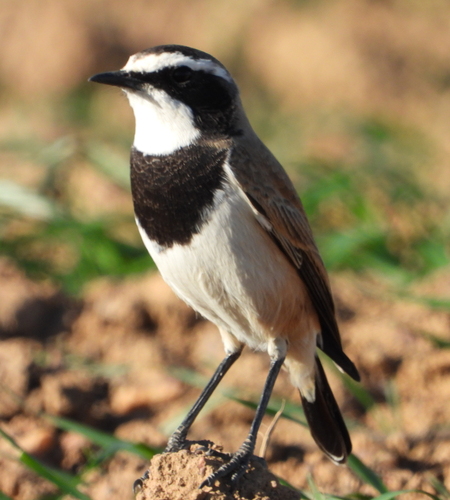
Spike-heeled Lark vs Capped Wheatear
Chersomanes albofasciata versus Oenanthe pileata
Play a quiz with Spike-heeled Lark and Capped Wheatear
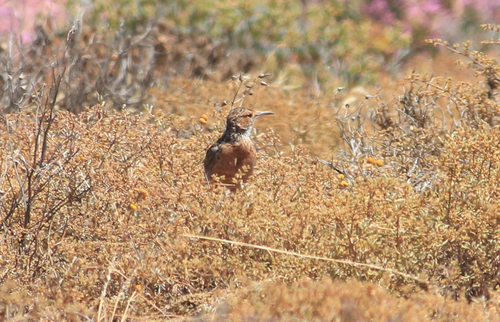
Spike-heeled Lark
Capped Wheatear
In short
The Spike-heeled Lark and Capped Wheatear are both ground-dwelling birds found in southern Africa, but they differ in structure and habitat preference. The Spike-heeled Lark is best identified by its long, spike-like hind claws and preference for arid grasslands, while the Capped Wheatear is distinguished by its bold black cap and white supercilium, often found in more open, less arid areas.
Identification tips
- Look for the long hind claws of the Spike-heeled Lark, a key structural feature. 2. Note the black cap and white supercilium of the Capped Wheatear. 3. Observe habitat: Spike-heeled Larks are in arid grasslands, while Capped Wheatears prefer open, less arid areas. 4. Behaviorally, Spike-heeled Larks may be near burrows, while Capped Wheatears perch on rocks.
Size
Both species are similar in size, but the Spike-heeled Lark may appear slightly bulkier due to its longer hind claws.
Plumage
The Spike-heeled Lark has a more uniform brown plumage with subtle streaking, while the Capped Wheatear is more striking with a black cap, white supercilium, and contrasting black and white facial markings.
Behaviour
Spike-heeled Larks often forage near rodent burrows and may seek refuge in them, whereas Capped Wheatears are more likely to be seen perched on rocks or low shrubs.
Habitat
Spike-heeled Larks prefer semi-arid grasslands and shrublands, often avoiding agricultural areas. Capped Wheatears are found in open habitats, including grasslands and savannas, and are less restricted to arid environments.
Voice
Vocalizations are not detailed in the sources, but generally, larks have more complex songs compared to wheatears.