Birdr

Spotted Redshank vs Common Greenshank

Tringa erythropus versus Tringa nebularia

Play a quiz with Spotted Redshank and Common Greenshank
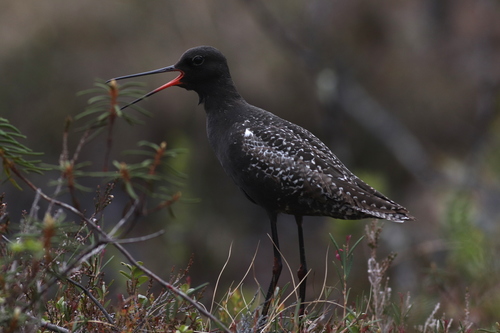
Spotted Redshank (Tringa erythropus) Spotted Redshank
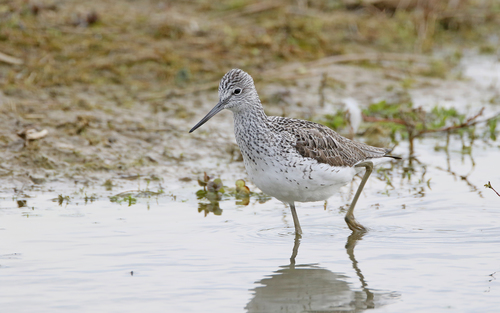
Common Greenshank (Tringa nebularia) Common Greenshank

Media

Loading…

In short

The bill shape is the most reliable field mark: the Spotted Redshank has a long, slender, slightly upturned bill, while the Common Greenshank's bill is thicker and slightly upturned. In breeding plumage, the Spotted Redshank is strikingly black, whereas the Common Greenshank remains a more muted grey-brown.

Identification tips

  1. Bill shape: Look for the slender, slightly upturned bill of the Spotted Redshank versus the thicker, slightly upturned bill of the Common Greenshank. 2. Breeding plumage: Note the black plumage of the Spotted Redshank in breeding season. 3. Call: Listen for the 'chew' call of the Spotted Redshank compared to the 'tew-tew-tew' of the Common Greenshank. 4. Behavior: Observe if the bird is swimming, which might suggest a Spotted Redshank.

Size

Both species are similar in size, but the Spotted Redshank is slightly more slender and elegant compared to the robust Common Greenshank.

Plumage

In non-breeding plumage, both species are grey, but the Spotted Redshank has a more uniform grey with less contrast between the upperparts and underparts. In breeding plumage, the Spotted Redshank turns almost entirely black, while the Common Greenshank remains grey-brown.

Behaviour

Both species are active foragers, often seen wading in shallow water. The Spotted Redshank may be more likely to be seen swimming.

Habitat

Both species frequent similar wetland habitats, including marshes, estuaries, and mudflats, but the Spotted Redshank may be found in slightly deeper water.

Voice

The Spotted Redshank's call is a distinctive 'chew' or 'chuet,' while the Common Greenshank has a more ringing 'tew-tew-tew' call.

Submit a better description

Use the same sections as the comparison. Your text is published immediately.

The bill shape is the most reliable field mark: the Spotted Redshank has a long, slender, slightly upturned bill, while the Common Greenshank's bill is thicker and slightly upturned. In breeding plumage, the Spotted Redshank is strikingly black, whereas the Common Greenshank remains a more muted grey-brown.

  1. Bill shape: Look for the slender, slightly upturned bill of the Spotted Redshank versus the thicker, slightly upturned bill of the Common Greenshank. 2. Breeding plumage: Note the black plumage of the Spotted Redshank in breeding season. 3. Call: Listen for the 'chew' call of the Spotted Redshank compared to the 'tew-tew-tew' of the Common Greenshank. 4. Behavior: Observe if the bird is swimming, which might suggest a Spotted Redshank.

Both species are similar in size, but the Spotted Redshank is slightly more slender and elegant compared to the robust Common Greenshank.

In non-breeding plumage, both species are grey, but the Spotted Redshank has a more uniform grey with less contrast between the upperparts and underparts. In breeding plumage, the Spotted Redshank turns almost entirely black, while the Common Greenshank remains grey-brown.

Both species are active foragers, often seen wading in shallow water. The Spotted Redshank may be more likely to be seen swimming.

Both species frequent similar wetland habitats, including marshes, estuaries, and mudflats, but the Spotted Redshank may be found in slightly deeper water.

The Spotted Redshank's call is a distinctive 'chew' or 'chuet,' while the Common Greenshank has a more ringing 'tew-tew-tew' call.

Discard your changes?

You have unsaved edits. If you leave now, those changes will be lost.

Spotted Redshank · Common Greenshank · My Tricky Birds