
Birdr

Spotted Sandpiper vs Grey-tailed Tattler

Actitis macularius versus Tringa brevipes

Play a quiz with Spotted Sandpiper and Grey-tailed Tattler
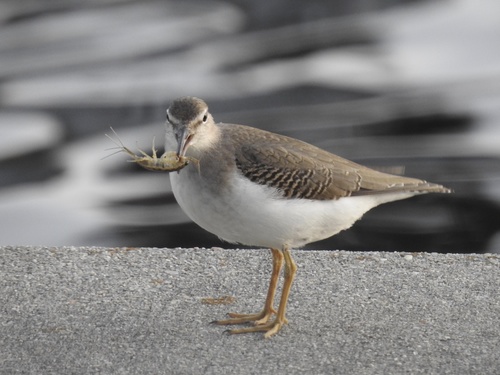
Spotted Sandpiper (Actitis macularius) Spotted Sandpiper
Grey-tailed Tattler (Tringa brevipes) Grey-tailed Tattler

Media

Loading…

In short

The Spotted Sandpiper and Grey-tailed Tattler can be distinguished by the Spotted Sandpiper's distinctive teetering behavior and bold black spotting on the underparts in alternate plumage. The Grey-tailed Tattler lacks these spots and has a more uniform grey appearance with a prominent white supercilium.

Identification tips

  1. Look for the Spotted Sandpiper's bold black spotting on the underparts in breeding plumage. 2. Observe the teetering behavior of the Spotted Sandpiper. 3. Note the Grey-tailed Tattler's uniform grey plumage and prominent white supercilium. 4. Listen for the Spotted Sandpiper's shrill 'peet-weet' call versus the Grey-tailed Tattler's more melodious call.

Size

Both are medium-sized shorebirds, but the Grey-tailed Tattler is slightly larger than the Spotted Sandpiper.

Plumage

Spotted Sandpiper shows bold black spotting on the underparts during the breeding season, while the Grey-tailed Tattler is uniformly grey with a prominent white supercilium and lacks spotting.

Behaviour

Spotted Sandpiper exhibits a distinctive teetering motion, which is more frequent and obvious than the Grey-tailed Tattler's movements.

Habitat

Spotted Sandpipers are found near freshwater bodies across North America, while Grey-tailed Tattlers are more coastal and found in Asia and Australasia.

Voice

Spotted Sandpiper's flight call is a shrill 'peet-weet', whereas the Grey-tailed Tattler's call is a more melodious and descending series of notes.

Submit a better description

Use the same sections as the comparison. Your text is published immediately.

The Spotted Sandpiper and Grey-tailed Tattler can be distinguished by the Spotted Sandpiper's distinctive teetering behavior and bold black spotting on the underparts in alternate plumage. The Grey-tailed Tattler lacks these spots and has a more uniform grey appearance with a prominent white supercilium.

  1. Look for the Spotted Sandpiper's bold black spotting on the underparts in breeding plumage. 2. Observe the teetering behavior of the Spotted Sandpiper. 3. Note the Grey-tailed Tattler's uniform grey plumage and prominent white supercilium. 4. Listen for the Spotted Sandpiper's shrill 'peet-weet' call versus the Grey-tailed Tattler's more melodious call.

Both are medium-sized shorebirds, but the Grey-tailed Tattler is slightly larger than the Spotted Sandpiper.

Spotted Sandpiper shows bold black spotting on the underparts during the breeding season, while the Grey-tailed Tattler is uniformly grey with a prominent white supercilium and lacks spotting.

Spotted Sandpiper exhibits a distinctive teetering motion, which is more frequent and obvious than the Grey-tailed Tattler's movements.

Spotted Sandpipers are found near freshwater bodies across North America, while Grey-tailed Tattlers are more coastal and found in Asia and Australasia.

Spotted Sandpiper's flight call is a shrill 'peet-weet', whereas the Grey-tailed Tattler's call is a more melodious and descending series of notes.

Discard your changes?

You have unsaved edits. If you leave now, those changes will be lost.

Spotted Sandpiper · Grey-tailed Tattler · My Tricky Birds