
Spotted Sandpiper vs Solitary Sandpiper
Actitis macularius versus Tringa solitaria
Play a quiz with Spotted Sandpiper and Solitary Sandpiper
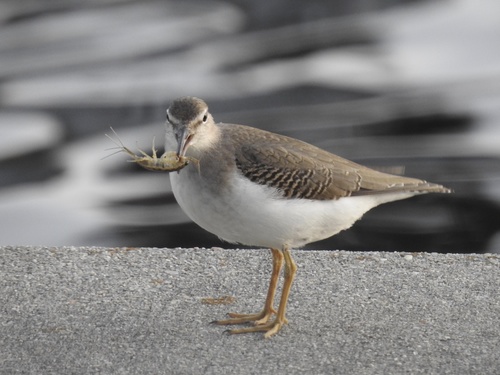 Spotted Sandpiper
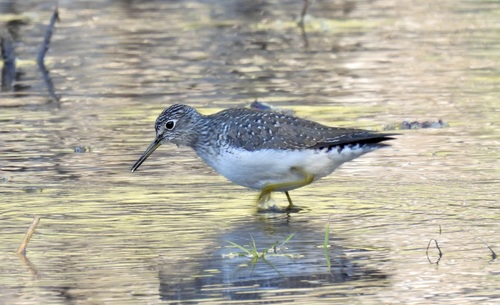 Solitary Sandpiper
In short
The most reliable field mark to separate Spotted Sandpiper from Solitary Sandpiper—especially in flight or on immature/nonbreeding birds—is the rump and tail pattern: Spotted Sandpiper shows a plain brown back with no contrasting rump, while Solitary Sandpiper has a distinctly dark rump and tail center, which stands out in flight. On the ground, Spotted Sandpiper in breeding plumage is unmistakable with its bold black spots below, but in nonbreeding or immature plumage, it can look very similar to Solitary Sandpiper, so focus on leg color (yellowish in Spotted, greenish or grayish in Solitary) and bill color. Solitary Sandpiper is slightly larger and dumpier, with a darker, more uniform back and a more contrasting neck and chest pattern. Both species bob their tails, but Spotted Sandpiper does so more persistently and with a stiffer gait. Use flight views and leg color as your primary tools when plumage is ambiguous.
Identification tips
- Rump and tail pattern in flight (all ages): Spotted Sandpiper shows a plain brown back and rump, while Solitary Sandpiper has a dark rump and tail center that contrasts with the rest of the body. This is the most reliable mark in flight, especially for immatures and nonbreeding birds.
- Wing pattern in flight (all ages): Spotted Sandpiper has a more washed-out wing pattern, lacking strong contrast, while Solitary Sandpiper’s wings are dark above and below, matching the dark rump.
- Underpart spots (breeding adult Spotted only): Breeding Spotted Sandpiper has bold black spots on white underparts. No other age or Solitary Sandpiper ever shows this.
- Leg color (all ages): Spotted Sandpiper has yellowish legs and feet, while Solitary Sandpiper has greenish or grayish legs. This is visible in good light and at close range.
- Bill color (all ages): Spotted Sandpiper’s bill is orange with a dark tip; Solitary Sandpiper’s bill is less brightly colored, blending more with the head.
- Supercilium (all ages): Spotted Sandpiper has a white supercilium (eyebrow), which can be a subtle but helpful mark.
- Back and upperparts (all ages): Solitary Sandpiper has a darker, more uniform greenish back, while Spotted Sandpiper is browner and paler above.
- Neck and chest pattern (all ages): Solitary Sandpiper shows a more sharply defined, contrasting neck and chest pattern, while Spotted Sandpiper is plainer when not in breeding plumage.
- Body shape and jizz (all ages): Solitary Sandpiper looks dumpier and bulkier, with a slightly longer wingspan; Spotted Sandpiper is more slender and compact.
- Tail-bobbing behavior (all ages): Both species bob their tails, but Spotted Sandpiper does so more persistently and with a stiffer, more mechanical motion.
- Flight style (all ages): Spotted Sandpiper flies low over water with stiff, shallow wingbeats; Solitary Sandpiper’s flight is less stiff.
- Habitat preference (all ages): Spotted Sandpiper prefers open, muddy or sandy shores; Solitary Sandpiper is more often found at wooded ponds and marshes.
- Vocalization (all ages): If you hear a three-note whistle in flight, it is Solitary Sandpiper. Spotted Sandpiper’s call is not detailed here.
- Seasonal context: If you see a boldly spotted bird in spring or summer, it is a breeding Spotted Sandpiper. In fall and winter, rely on flight and structural marks.
- Pitfall: Nonbreeding and immature Spotted Sandpipers can look very similar to Solitary Sandpiper on the ground—do not rely on underpart spotting outside breeding season; use rump pattern, leg color, and flight marks instead.
Size
Spotted Sandpiper is slightly smaller and lighter than Solitary Sandpiper. Spotted Sandpiper measures 18–20 cm in length, with a wingspan of 37–40 cm and a mass of 34–50 g. Solitary Sandpiper is longer (18–23 cm), with a wingspan up to 50 cm and a mass range of 31–65 g (mean 48.6 g). In the field, Solitary Sandpiper often looks a bit bulkier and longer-winged, but the difference is subtle and not always reliable at a distance.
Plumage
For immature and nonbreeding birds—the most confusing ages—focus first on the upperwing and rump in flight. Spotted Sandpiper has a more washed-out wing pattern with no strong contrast, and a plain brown back and rump. Solitary Sandpiper, by contrast, shows a dark rump and tail center that is obvious in flight, with dark wings above and below. On the ground, breeding Spotted Sandpiper is easy with its bold black spots below, but in nonbreeding and immature plumage, it lacks spots and appears very similar to Solitary Sandpiper. Spotted Sandpiper has a white supercilium and yellowish legs, while Solitary Sandpiper has a darker, more uniform back, a greyish head and breast, and greenish or grayish legs. Both have brown wings with light dots, but Solitary’s neck and chest pattern is more sharply defined. Spot size and shape on Spotted Sandpiper become smaller and more irregular with age, but this is only useful in breeding plumage.
Behaviour
Both species exhibit a tail-bobbing walk, but Spotted Sandpiper does so more persistently and with a distinctive, stiff gait. In flight, both species fly low over water, but Spotted Sandpiper’s flight is stiffer-winged. Solitary Sandpiper is often seen alone, as its name suggests, and tends to be more secretive and less approachable. Spotted Sandpiper is more likely to be seen actively foraging along open shorelines.
Habitat
Both species are found near water, but Spotted Sandpiper is more likely to be seen along open, muddy or sandy shores, riverbanks, and lake edges. Solitary Sandpiper prefers wooded ponds, marshes, and quieter backwaters, and is less likely to be found on open mudflats. Both nest in unusual places for shorebirds: Solitary Sandpiper often nests in trees, while Spotted Sandpiper nests on the ground.
Voice
Solitary Sandpiper has a distinctive three-note whistle in flight, which can be a useful field mark if heard. Spotted Sandpiper’s call is not described in the provided notes, so voice is only diagnostic if you hear the Solitary’s whistle.