Birdr

Spur-winged Lapwing vs Sociable Lapwing

Vanellus spinosus versus Vanellus gregarius

Play a quiz with Spur-winged Lapwing and Sociable Lapwing
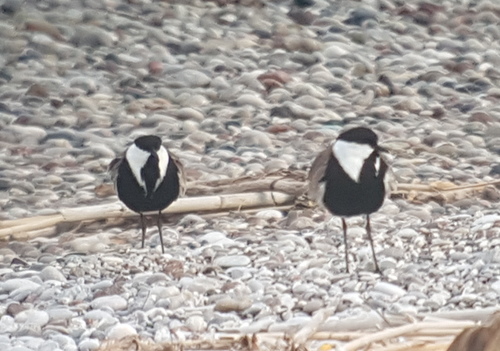
Spur-winged Lapwing (Vanellus spinosus) Spur-winged Lapwing
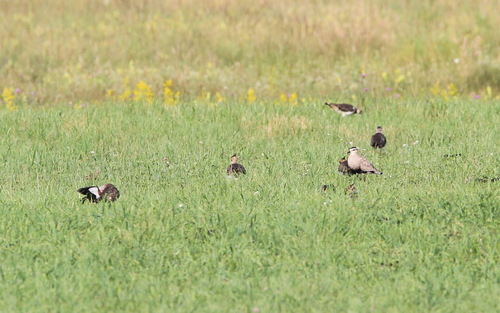
Sociable Lapwing (Vanellus gregarius) Sociable Lapwing

Media

Loading…

In short

The Spur-winged Lapwing is best identified by its distinctive black crown and nape extending down to a black breast band, while the Sociable Lapwing has a more uniform brownish-grey head with a white supercilium. Both species are similar in size and structure, but their plumage and habitat preferences can help differentiate them.

Identification tips

  1. Look for the black crown and nape extending into a breast band in the Spur-winged Lapwing. 2. Check for the white supercilium and lack of a breast band in the Sociable Lapwing. 3. Consider habitat: near water for Spur-winged, dry grasslands for Sociable. 4. Observe flock size: Sociable Lapwings often in larger groups.

Size

Both species are similar in size, typical of lapwings, with no significant differences in structure or proportions.

Plumage

The Spur-winged Lapwing has a striking black crown and nape, contrasting with its white face and throat, and a black breast band. In contrast, the Sociable Lapwing has a more muted head with a white supercilium and lacks the black breast band. The Sociable Lapwing also has a more uniform brownish-grey upperpart.

Behaviour

Both species exhibit typical lapwing behavior, often seen in open areas. The Spur-winged Lapwing is more likely to be seen in pairs or small groups, while the Sociable Lapwing can be found in larger flocks, especially during migration.

Habitat

The Spur-winged Lapwing is often found near water bodies like rivers and lakes, while the Sociable Lapwing prefers dry grasslands and steppe regions. This habitat preference can be a useful clue when identifying these species.

Voice

Vocalizations are not the most reliable differentiator in the field, but the Spur-winged Lapwing is known for its loud, harsh calls, whereas the Sociable Lapwing has a softer, more melodious call.

Submit a better description

Use the same sections as the comparison. Your text is published immediately.

The Spur-winged Lapwing is best identified by its distinctive black crown and nape extending down to a black breast band, while the Sociable Lapwing has a more uniform brownish-grey head with a white supercilium. Both species are similar in size and structure, but their plumage and habitat preferences can help differentiate them.

  1. Look for the black crown and nape extending into a breast band in the Spur-winged Lapwing. 2. Check for the white supercilium and lack of a breast band in the Sociable Lapwing. 3. Consider habitat: near water for Spur-winged, dry grasslands for Sociable. 4. Observe flock size: Sociable Lapwings often in larger groups.

Both species are similar in size, typical of lapwings, with no significant differences in structure or proportions.

The Spur-winged Lapwing has a striking black crown and nape, contrasting with its white face and throat, and a black breast band. In contrast, the Sociable Lapwing has a more muted head with a white supercilium and lacks the black breast band. The Sociable Lapwing also has a more uniform brownish-grey upperpart.

Both species exhibit typical lapwing behavior, often seen in open areas. The Spur-winged Lapwing is more likely to be seen in pairs or small groups, while the Sociable Lapwing can be found in larger flocks, especially during migration.

The Spur-winged Lapwing is often found near water bodies like rivers and lakes, while the Sociable Lapwing prefers dry grasslands and steppe regions. This habitat preference can be a useful clue when identifying these species.

Vocalizations are not the most reliable differentiator in the field, but the Spur-winged Lapwing is known for its loud, harsh calls, whereas the Sociable Lapwing has a softer, more melodious call.

Discard your changes?

You have unsaved edits. If you leave now, those changes will be lost.

Spur-winged Lapwing · Sociable Lapwing · My Tricky Birds