
Squacco Heron vs Western Cattle-Egret
Ardeola ralloides versus Ardea ibis
Play a quiz with Squacco Heron and Western Cattle-Egret
 Squacco Heron
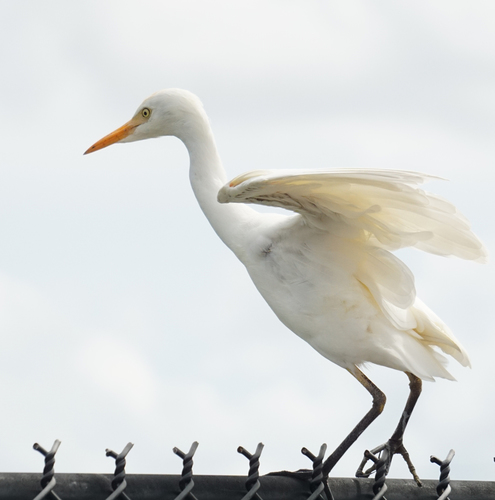 Western Cattle-Egret
In short
The most reliable field mark is the transformation of the Squacco Heron in flight: its upperwings appear strikingly white, contrasting with its buff-brown body, while the Western Cattle-Egret is white both at rest and in flight, with only subtle orange-buff plumes in breeding season. Squacco Herons show a tawny or buffy appearance when perched, but this vanishes in flight, often leading to confusion. Structurally, Squacco Herons are smaller and more compact, with a shorter neck and bill, while Cattle-Egrets are slightly larger and have a thicker, sturdier appearance. Both species can be found in similar wetland habitats, but Cattle-Egrets are more likely to be seen foraging in drier fields, often near livestock, while Squacco Herons stick to marshy wetlands. Careful attention to flight views, bill structure, and context will help separate these two species.
Identification tips
- Flight view is critical: Squacco Heron appears white above in flight due to its white wings, but looks buffy or tawny when perched; Cattle-Egret is always white in flight and at rest (except for limited orange-buff plumes in breeding adults).
- Perched coloration: Squacco Heron shows a buff-brown back and upperparts with lighter streaking when perched, especially outside breeding season; Cattle-Egret is plain white except for breeding plumes.
- Bill structure: Squacco Heron has a short, thick, and relatively delicate bill; Cattle-Egret's bill is thicker, sturdier, and appears more robust, turning bright red briefly in peak breeding plumage.
- Neck and posture: Squacco Heron has a short neck and compact, stocky build, often appearing hunched; Cattle-Egret has a thicker neck and a more upright, chunky posture.
- Breeding plumes: In breeding season, Squacco Heron develops long neck feathers; Cattle-Egret develops orange-buff plumes on the crown, breast, and back, but these are much less extensive than the Squacco's overall buffy coloration.
- Juvenile confusion: Juvenile Cattle-Egrets are white with a black bill and lack colored plumes; juvenile Squacco Herons are tawny with lighter streaking and never fully white when perched.
- Leg color: Cattle-Egret's legs turn bright red briefly in breeding season; Squacco Heron's legs are not described as changing color.
- Habitat context: Cattle-Egrets are often found in dry fields, pastures, and with livestock; Squacco Herons are almost always in marshy or wetland habitats.
- Group size: Cattle-Egrets are often in flocks, especially near cattle; Squacco Herons are more solitary or in small groups.
- Behavior: Cattle-Egrets walk with a more upright gait in open areas; Squacco Herons are more skulking and secretive, moving slowly along water edges.
- Bill color in juveniles: Juvenile Cattle-Egrets have a black bill; Squacco Heron juveniles have a smaller, paler bill.
- Seasonal context: In Europe and the Middle East, Squacco Heron is a summer breeder and migrates south in winter; Cattle-Egret can be present year-round in many areas.
- Potential confusion: In poor light or at distance, a perched Squacco Heron may look pale and be mistaken for a Cattle-Egret; always try to see the bird in flight or note the habitat and posture.
- Colony nesting: Both species may nest in mixed colonies, but Cattle-Egret colonies are often larger and noisier.
- Vocalization: Cattle-Egret's 'rick-rack' call is rarely heard away from colonies; Squacco Heron is generally silent, so voice is not usually helpful.
Size
Squacco Heron is slightly smaller, with a body length of 44–47 cm and a body mass around 288 g [wikidata]. Western Cattle-Egret is a bit larger, at 46–56 cm in length and a wingspan of 88–96 cm [wikipedia]. The Cattle-Egret is also heavier (270–512 g), with a more robust build. In the field, the Cattle-Egret often looks chunkier and more upright, while the Squacco Heron appears more compact and short-necked.
Plumage
Juvenile and non-breeding Squacco Herons have tawny or buff-brown upperparts with lighter streaking and a buff back, but in flight, their wings are bright white—this contrast is a key field mark for all ages except in poor light. Western Cattle-Egrets are white throughout the year, with juveniles lacking any colored plumes and having a black bill. In breeding season, adult Cattle-Egrets develop orange-buff plumes on the crown, breast, and back, but these are limited in extent and never as extensive as the Squacco's overall buffy body. The Cattle-Egret's bill and legs turn bright red briefly before pairing, while the Squacco Heron's bill remains shorter and more delicate. At rest, Squacco Herons can look similar to Cattle-Egrets if only the head and neck are visible, but the overall tawny coloration and shorter bill are clues. In flight, Cattle-Egrets remain white, while Squacco Herons become much paler above due to their white wings.
Behaviour
Squacco Herons are typically solitary or in small groups, foraging quietly in marshes and wetlands. They are more skulking and less likely to be seen in open fields. Western Cattle-Egrets are highly gregarious, often found in large flocks, especially near grazing animals, and are more terrestrial in their foraging habits. Cattle-Egrets are also more likely to be seen walking in open grassland or agricultural fields, sometimes far from water, while Squacco Herons stick closely to wet habitats.
Habitat
Squacco Herons are wetland specialists, breeding and feeding in marshy wetlands, reedbeds, and the edges of lakes and rivers. Western Cattle-Egrets are more versatile, commonly found in open grasslands, pastures, and agricultural fields, often in association with livestock, as well as in wetlands. If you see a small white heron in a dry field with cattle, it is almost certainly a Cattle-Egret; in a reedy marsh, both are possible, but Squacco Heron is more likely.
Voice
Cattle-Egrets give a quiet, throaty 'rick-rack' call at breeding colonies but are otherwise largely silent. No distinctive vocalization is noted for Squacco Heron in these sources, so voice is not a reliable separation feature in the field.