Birdr

Steller's Eider vs Common Eider

Polysticta stelleri versus Somateria mollissima

Play a quiz with Steller's Eider and Common Eider

Steller's Eider (Polysticta stelleri) Steller's Eider
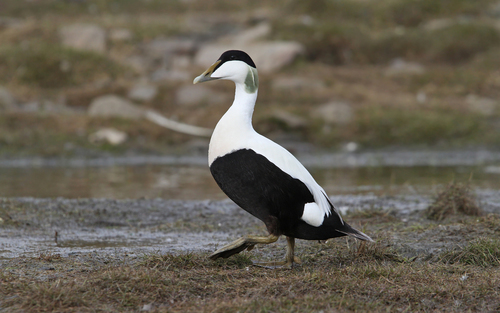
Common Eider (Somateria mollissima) Common Eider

Media

Loading…

In short

Steller's Eider and Common Eider can be distinguished by their size and plumage patterns. Steller's Eider is smaller and more compact, with distinctive white and black plumage in males, while Common Eider is larger with a more uniform color and a distinctive sloping forehead. Both species are sea ducks, but they have different habitat preferences and behaviors.

Identification tips

  1. Size: Look for the smaller size of Steller's Eider compared to the larger Common Eider. 2. Male Plumage: Note the striking white and black pattern of male Steller's Eider versus the more uniform appearance of male Common Eider. 3. Female Plumage: Female Steller's Eider is more uniformly brown, while female Common Eider has more patterning. 4. Head Shape: Common Eider has a distinctive sloping forehead. 5. Habitat: Consider the habitat; Steller's Eider is more likely in northern, shallow marine waters, while Common Eider is found in a broader range of coastal environments.

Size

Steller's Eider is notably smaller and more compact than the larger Common Eider.

Plumage

Male Steller's Eiders have striking white and black plumage with a greenish head, while male Common Eiders have a more uniform appearance with a sloping forehead and a pale green nape. Female Steller's Eiders are more uniformly brown compared to the more patterned brown of female Common Eiders.

Behaviour

Both species are sea ducks, but Steller's Eider often forms large aggregations in nonbreeding seasons, while Common Eider is known for its crèche behavior where females group their ducklings together.

Habitat

Steller's Eider nests near freshwater tundra ponds and winters in shallow marine waters, primarily in northern latitudes. Common Eider is more widespread, often found in coastal marine environments and is less restricted to northern latitudes.

Submit a better description

Use the same sections as the comparison. Your text is published immediately.

Steller's Eider and Common Eider can be distinguished by their size and plumage patterns. Steller's Eider is smaller and more compact, with distinctive white and black plumage in males, while Common Eider is larger with a more uniform color and a distinctive sloping forehead. Both species are sea ducks, but they have different habitat preferences and behaviors.

  1. Size: Look for the smaller size of Steller's Eider compared to the larger Common Eider. 2. Male Plumage: Note the striking white and black pattern of male Steller's Eider versus the more uniform appearance of male Common Eider. 3. Female Plumage: Female Steller's Eider is more uniformly brown, while female Common Eider has more patterning. 4. Head Shape: Common Eider has a distinctive sloping forehead. 5. Habitat: Consider the habitat; Steller's Eider is more likely in northern, shallow marine waters, while Common Eider is found in a broader range of coastal environments.

Steller's Eider is notably smaller and more compact than the larger Common Eider.

Male Steller's Eiders have striking white and black plumage with a greenish head, while male Common Eiders have a more uniform appearance with a sloping forehead and a pale green nape. Female Steller's Eiders are more uniformly brown compared to the more patterned brown of female Common Eiders.

Both species are sea ducks, but Steller's Eider often forms large aggregations in nonbreeding seasons, while Common Eider is known for its crèche behavior where females group their ducklings together.

Steller's Eider nests near freshwater tundra ponds and winters in shallow marine waters, primarily in northern latitudes. Common Eider is more widespread, often found in coastal marine environments and is less restricted to northern latitudes.

Discard your changes?

You have unsaved edits. If you leave now, those changes will be lost.

Steller's Eider · Common Eider · My Tricky Birds