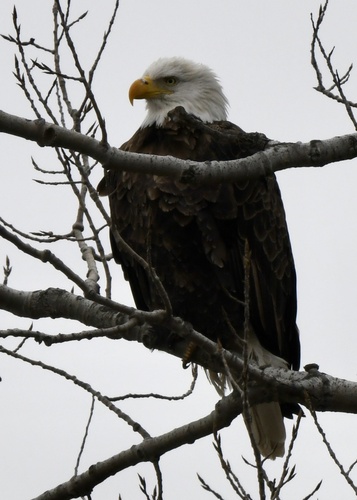
Steller's Sea-Eagle vs Bald Eagle
Haliaeetus pelagicus versus Haliaeetus leucocephalus
Play a quiz with Steller's Sea-Eagle and Bald Eagle

Steller's Sea-Eagle
Bald Eagle
In short
Steller's Sea-Eagle and Bald Eagle are both large, powerful raptors, but they can be distinguished by size, plumage, and bill shape. Steller's Sea-Eagle is notably larger with a massive bill and distinctive plumage patterns, while the Bald Eagle is slightly smaller with a characteristic white head and tail in adults.
Identification tips
- Size and Bill: Steller's Sea-Eagle is larger with a massive, yellow bill. 2. Plumage: Look for the white shoulder patches and tail in Steller's. Bald Eagles have a white head and tail in adults. 3. Juvenile Confusion: Juvenile Bald Eagles are mottled brown but lack the white patches of Steller's. 4. Habitat: Consider the location; Steller's is in Asia, Bald Eagles in North America. 5. Vocalization: Use calls as a secondary check; Bald Eagles have a high-pitched whistle.
Size
Steller's Sea-Eagle is larger and bulkier than the Bald Eagle, with a wingspan reaching up to 2.5 meters compared to the Bald Eagle's maximum of about 2.3 meters.
Plumage
Adult Steller's Sea-Eagle has a dark brown body with a striking white tail and white shoulder patches, while the Bald Eagle is known for its white head and tail contrasting with a dark brown body. Juvenile Bald Eagles can be confused with Steller's due to their mottled brown plumage, but lack the white shoulder patches.
Behaviour
Both species are often seen near water, hunting for fish. Steller's Sea-Eagle may appear more solitary or in smaller groups compared to the Bald Eagle, which can be seen in larger congregations, especially during winter.
Habitat
Steller's Sea-Eagle is primarily found in coastal regions of northeastern Asia, while the Bald Eagle is widespread across North America, often near large bodies of open water with abundant fish.
Voice
The Bald Eagle has a distinctive, high-pitched whistling call, whereas Steller's Sea-Eagle's call is deeper and more guttural, though vocalizations are not the most reliable field marks.