Stone-curlew vs European Golden Plover
Burhinus oedicnemus versus Pluvialis apricaria
Play a quiz with Stone-curlew and European Golden Plover
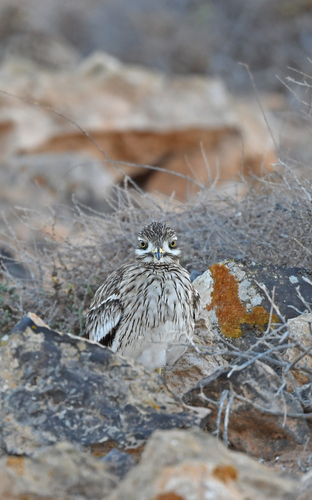
Stone-curlew
European Golden Plover
In short
The Stone-curlew and European Golden Plover can be distinguished primarily by their structure and plumage. The Stone-curlew has a more robust build with a large head and thick bill, while the European Golden Plover is more slender with a finer bill. In terms of plumage, the Stone-curlew is sandy-brown with bold yellow eyes, whereas the European Golden Plover is speckled gold and black, especially in breeding plumage.
Identification tips
- Structure: Look for the Stone-curlew's large head and thick bill compared to the slender build and finer bill of the European Golden Plover. 2. Plumage: Note the sandy-brown color and yellow eyes of the Stone-curlew versus the speckled gold and black of the European Golden Plover. 3. Habitat: Consider the habitat; Stone-curlews are more likely in dry, open areas, while European Golden Plovers prefer moorlands and fields. 4. Vocalization: Listen for the Stone-curlew's eerie call versus the melodic whistle of the European Golden Plover.
Size
The Stone-curlew is larger and more robust than the European Golden Plover.
Plumage
The Stone-curlew has sandy-brown plumage with bold yellow eyes and a streaked appearance. The European Golden Plover is speckled gold and black, particularly striking in breeding plumage with a black face and belly.
Behaviour
Stone-curlews are often seen standing still or walking slowly, while European Golden Plovers are more active, frequently seen in flocks.
Habitat
Stone-curlews prefer dry, open habitats like grasslands and scrublands. European Golden Plovers are found in open moorlands and tundra during breeding and in agricultural fields and coastal areas in winter.
Voice
Stone-curlews have a distinctive, eerie wailing call, while European Golden Plovers have a more melodic, whistling call.