Birdr

Stub-tailed Spadebill vs White-throated Spadebill

Platyrinchus cancrominus versus Platyrinchus mystaceus

Play a quiz with Stub-tailed Spadebill and White-throated Spadebill
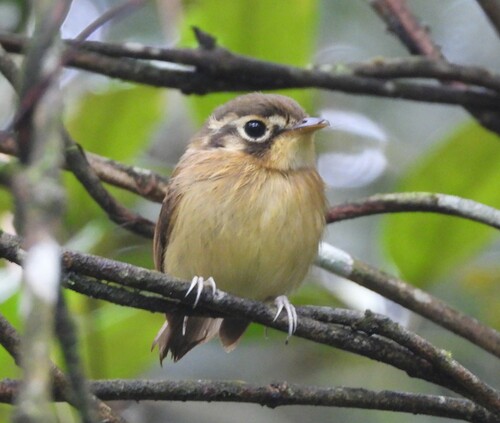
Stub-tailed Spadebill (Platyrinchus cancrominus) Stub-tailed Spadebill
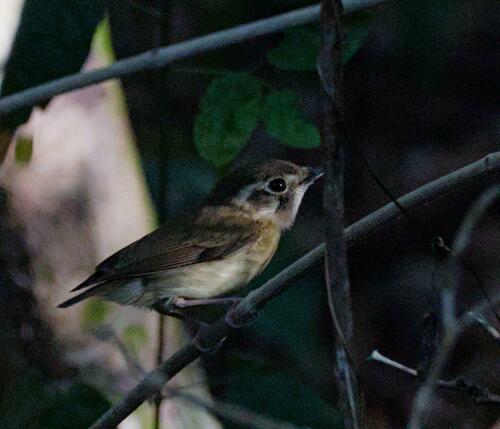
White-throated Spadebill (Platyrinchus mystaceus) White-throated Spadebill

Media

Loading…

In short

The Stub-tailed Spadebill and White-throated Spadebill are small, similar-looking flycatchers best distinguished by their tail length and throat coloration. The Stub-tailed Spadebill has a notably shorter tail and a more uniform throat, while the White-throated Spadebill features a distinct white throat patch.

Identification tips

  1. Look for the shorter tail of the Stub-tailed Spadebill. 2. Check for the white throat patch on the White-throated Spadebill. 3. Listen for vocalizations, particularly for the White-throated Spadebill. 4. Consider habitat and elevation, as the White-throated Spadebill is found across a wider range.

Size

Both species are small, but the Stub-tailed Spadebill has a shorter tail, giving it a more compact appearance.

Plumage

The Stub-tailed Spadebill has a more uniform throat coloration, whereas the White-throated Spadebill is characterized by its prominent white throat patch. Both have similar overall coloration with subtle differences in tone.

Behaviour

Both species are often found in the undergrowth and can be secretive, making them challenging to observe.

Habitat

The Stub-tailed Spadebill is typically found in lowland forests, while the White-throated Spadebill occupies a broader range from sea level to over 2150 m, though it is less common at higher elevations.

Voice

Vocalizations are important for identification, especially for the White-throated Spadebill, which is often located by its calls.

Submit a better description

Use the same sections as the comparison. Your text is published immediately.

The Stub-tailed Spadebill and White-throated Spadebill are small, similar-looking flycatchers best distinguished by their tail length and throat coloration. The Stub-tailed Spadebill has a notably shorter tail and a more uniform throat, while the White-throated Spadebill features a distinct white throat patch.

  1. Look for the shorter tail of the Stub-tailed Spadebill. 2. Check for the white throat patch on the White-throated Spadebill. 3. Listen for vocalizations, particularly for the White-throated Spadebill. 4. Consider habitat and elevation, as the White-throated Spadebill is found across a wider range.

Both species are small, but the Stub-tailed Spadebill has a shorter tail, giving it a more compact appearance.

The Stub-tailed Spadebill has a more uniform throat coloration, whereas the White-throated Spadebill is characterized by its prominent white throat patch. Both have similar overall coloration with subtle differences in tone.

Both species are often found in the undergrowth and can be secretive, making them challenging to observe.

The Stub-tailed Spadebill is typically found in lowland forests, while the White-throated Spadebill occupies a broader range from sea level to over 2150 m, though it is less common at higher elevations.

Vocalizations are important for identification, especially for the White-throated Spadebill, which is often located by its calls.

Discard your changes?

You have unsaved edits. If you leave now, those changes will be lost.

Stub-tailed Spadebill · White-throated Spadebill · My Tricky Birds