Birdr

Sulphur-rumped Flycatcher vs Grey-headed Piprites

Myiobius sulphureipygius versus Piprites griseiceps

Play a quiz with Sulphur-rumped Flycatcher and Grey-headed Piprites
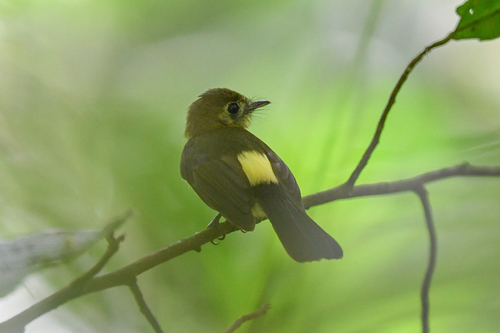
Sulphur-rumped Flycatcher (Myiobius sulphureipygius) Sulphur-rumped Flycatcher
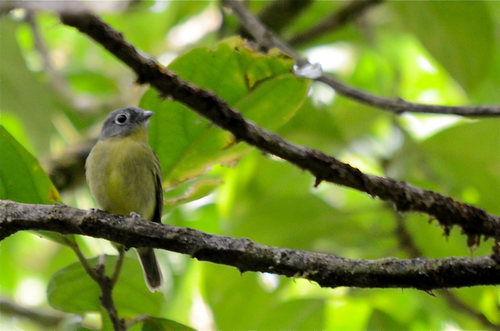
Grey-headed Piprites (Piprites griseiceps) Grey-headed Piprites

Media

Loading…

In short

The Sulphur-rumped Flycatcher and Grey-headed Piprites can be distinguished primarily by their plumage and behavior. The Sulphur-rumped Flycatcher has a distinctive yellow rump, while the Grey-headed Piprites features a grey head and lacks the bright rump coloration. Behaviorally, the flycatcher is more active in mixed-species flocks.

Identification tips

Look for the yellow rump on the Sulphur-rumped Flycatcher. Note the grey head of the Grey-headed Piprites. Observe behavior: the flycatcher is more active in mixed-species flocks. If unsure, focus on the presence or absence of the yellow rump as a key distinguishing feature.

Size

Both species are small passerines, but the Grey-headed Piprites is generally more robust in appearance.

Plumage

The Sulphur-rumped Flycatcher has a yellow rump and a more uniform olive-brown body, whereas the Grey-headed Piprites has a grey head and lacks the yellow rump, with more muted overall coloring.

Behaviour

Sulphur-rumped Flycatchers are often seen energetically hopping and joining mixed-species flocks, while Grey-headed Piprites are less likely to be seen in such flocks.

Habitat

Both species inhabit forested areas, but the Sulphur-rumped Flycatcher is more commonly associated with mixed-species flocks in the understory.

Voice

Vocalizations are not well-documented for either species in the sources, so rely on visual identification.

Submit a better description

Use the same sections as the comparison. Your text is published immediately.

The Sulphur-rumped Flycatcher and Grey-headed Piprites can be distinguished primarily by their plumage and behavior. The Sulphur-rumped Flycatcher has a distinctive yellow rump, while the Grey-headed Piprites features a grey head and lacks the bright rump coloration. Behaviorally, the flycatcher is more active in mixed-species flocks.

Look for the yellow rump on the Sulphur-rumped Flycatcher. Note the grey head of the Grey-headed Piprites. Observe behavior: the flycatcher is more active in mixed-species flocks. If unsure, focus on the presence or absence of the yellow rump as a key distinguishing feature.

Both species are small passerines, but the Grey-headed Piprites is generally more robust in appearance.

The Sulphur-rumped Flycatcher has a yellow rump and a more uniform olive-brown body, whereas the Grey-headed Piprites has a grey head and lacks the yellow rump, with more muted overall coloring.

Sulphur-rumped Flycatchers are often seen energetically hopping and joining mixed-species flocks, while Grey-headed Piprites are less likely to be seen in such flocks.

Both species inhabit forested areas, but the Sulphur-rumped Flycatcher is more commonly associated with mixed-species flocks in the understory.

Vocalizations are not well-documented for either species in the sources, so rely on visual identification.

Discard your changes?

You have unsaved edits. If you leave now, those changes will be lost.

Sulphur-rumped Flycatcher · Grey-headed Piprites · My Tricky Birds