Birdr

Surf Scoter vs Common Scoter

Melanitta perspicillata versus Melanitta nigra

Play a quiz with Surf Scoter and Common Scoter
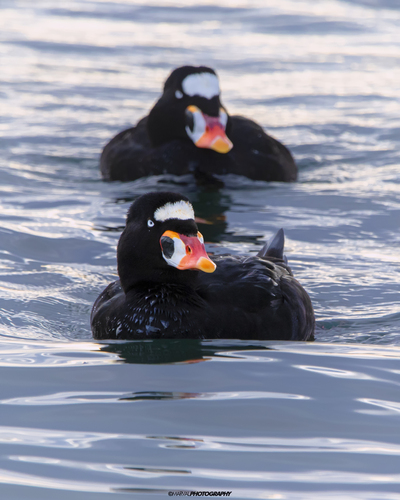
Surf Scoter (Melanitta perspicillata) Surf Scoter
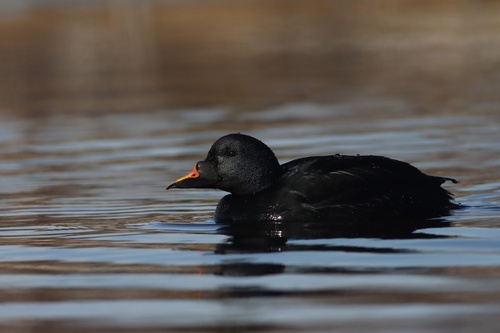
Common Scoter (Melanitta nigra) Common Scoter

Media

Loading…

In short

The Surf Scoter (Melanitta perspicillata) and Common Scoter (Melanitta nigra) are both large diving ducks, but they can be distinguished by their plumage patterns, bill shapes, and vocalizations. The Surf Scoter features distinct white patches on its head and a multicolored bill, while the Common Scoter is generally darker with a more uniformly colored bill lacking white markings.

Identification tips

  1. Birds of the World Similar-Species Diagnostics:
  2. The Surf Scoter is most similar to the Black Scoter (Melanitta americana) and White-winged Scoter (Melanitta deglandi). At rest, the adult male is easily distinguished from other scoters by white patches on the head and bill pattern. The adult female Surf Scoter is the only scoter with a whitish patch on the nape. In flight, the wing of the Surf Scoter is completely dark, unlike the White-winged Scoter, which has a white patch on the wing (secondary feathers) (source: Birds of the World).

  3. AI Field Diagnostics:

  4. Bill Shape and Color: The Surf Scoter's bill features a distinct multicolored pattern, while the Common Scoter's bill is mostly dark with less color variation. Pay attention to the shape; the Surf Scoter has a more swollen bill.
  5. Head Markings: Look for the distinctive white facial patches on the Surf Scoter, which are absent on the Common Scoter. The Surf Scoter's female has a paler face than the Common Scoter.
  6. Overall Coloration: The adult male Surf Scoter is entirely black with white patches, while the Common Scoter is more uniformly dark without white markings. If you're observing females, note the whitish nape on the Surf Scoter female, which is absent in the Common Scoter.
  7. Flight Patterns: When viewing in flight, the Surf Scoter will show completely dark wings, while the Common Scoter has a more varied wing coloration.
  8. Behavior: If you see a large flock at sea, it's likely to be Common Scoters, while Surf Scoters are often seen in smaller groups.

These tips should assist birdwatchers in distinguishing between the Surf Scoter and the Common Scoter in the field.

Size

Plumage

Behaviour

Habitat

Voice

Submit a better description

Use the same sections as the comparison. Your text is published immediately.

The Surf Scoter (Melanitta perspicillata) and Common Scoter (Melanitta nigra) are both large diving ducks, but they can be distinguished by their plumage patterns, bill shapes, and vocalizations. The Surf Scoter features distinct white patches on its head and a multicolored bill, while the Common Scoter is generally darker with a more uniformly colored bill lacking white markings.

  1. Birds of the World Similar-Species Diagnostics:
  2. The Surf Scoter is most similar to the Black Scoter (Melanitta americana) and White-winged Scoter (Melanitta deglandi). At rest, the adult male is easily distinguished from other scoters by white patches on the head and bill pattern. The adult female Surf Scoter is the only scoter with a whitish patch on the nape. In flight, the wing of the Surf Scoter is completely dark, unlike the White-winged Scoter, which has a white patch on the wing (secondary feathers) (source: Birds of the World).

  3. AI Field Diagnostics:

  4. Bill Shape and Color: The Surf Scoter's bill features a distinct multicolored pattern, while the Common Scoter's bill is mostly dark with less color variation. Pay attention to the shape; the Surf Scoter has a more swollen bill.
  5. Head Markings: Look for the distinctive white facial patches on the Surf Scoter, which are absent on the Common Scoter. The Surf Scoter's female has a paler face than the Common Scoter.
  6. Overall Coloration: The adult male Surf Scoter is entirely black with white patches, while the Common Scoter is more uniformly dark without white markings. If you're observing females, note the whitish nape on the Surf Scoter female, which is absent in the Common Scoter.
  7. Flight Patterns: When viewing in flight, the Surf Scoter will show completely dark wings, while the Common Scoter has a more varied wing coloration.
  8. Behavior: If you see a large flock at sea, it's likely to be Common Scoters, while Surf Scoters are often seen in smaller groups.

These tips should assist birdwatchers in distinguishing between the Surf Scoter and the Common Scoter in the field.

  • Surf Scoter: Males measure approximately 48 cm in length and weigh around 1,050 g, while females are about 44 cm and 900 g.
  • Common Scoter: Males range from 43–54 cm in length and weigh between 964–1,339 g, with females slightly smaller at 973–1,233 g.
  • Surf Scoter: The adult male in alternate plumage is entirely velvety black except for a white patch on the forehead and a larger white triangle on the nape. The bill is large and multicolored, featuring patterns of white, red, yellow, and a black patch near the base. The female is dark brown with two indistinct whitish patches on the cheeks and a variable whitish patch on the nape.
  • Common Scoter: The adult male is sooty black with dull black or dark olive-grey legs and a yellow patch on the culmen. The female is brownish-black with a more uniform appearance and lacks the white markings found in the Surf Scoter. The bill is generally dull black with little color variation.
  • Surf Scoter: Typically seen in smaller, looser groups, often foraging among other sea ducks. Their flight is characterized by a rapid, direct pattern.
  • Common Scoter: Forms large, dense flocks at sea, especially in winter, and tends to dive synchronously with other species. Their flight action is light and fast, giving them a long-necked appearance on water.
  • Surf Scoter: Prefers coastal marine environments, often found in shallow waters near shorelines.
  • Common Scoter: Inhabits coastal waters and estuaries, particularly in winter, and can also be found on inland water bodies during migration.
  • Surf Scoter: Generally silent, but males produce thin, piping whistles that can be heard over distances in calm weather.
  • Common Scoter: Typically silent as well, but both sexes can produce harsh rasping notes and "gyu" calls during migration.

Discard your changes?

You have unsaved edits. If you leave now, those changes will be lost.

Surf Scoter · Common Scoter · My Tricky Birds