
Swainson's Thrush vs Hermit Thrush
Catharus ustulatus versus Catharus guttatus
Play a quiz with Swainson's Thrush and Hermit Thrush
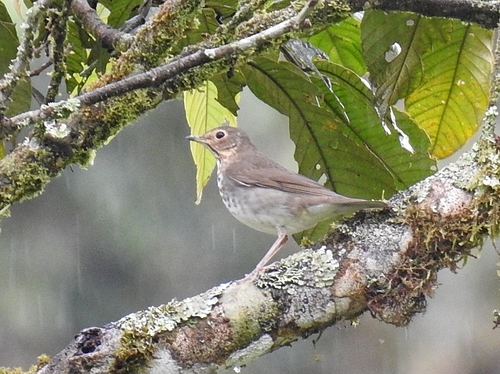 Swainson's Thrush
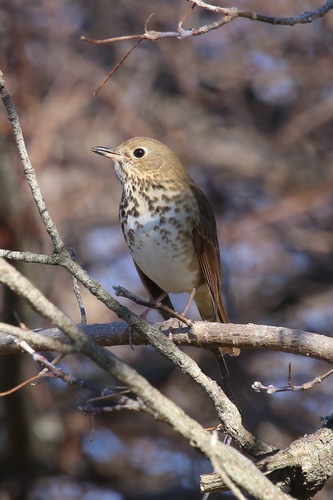 Hermit Thrush
In short
The most reliable field mark between Swainson's Thrush and Hermit Thrush is the tail color: Hermit Thrush shows a distinctly reddish tail that contrasts with its browner or grayer back, while Swainson's Thrush has a tail that matches the color of its upperparts. Both species share the Catharus white-dark-white underwing pattern, so this is not useful for separation. Swainson's is generally a bit larger and longer-winged, but size overlap is considerable. Subtle differences in eye ring, flank color, and overall jizz can help, but tail color is the single best mark in most field situations. Song structure is very different if heard.
Identification tips
- Tail color is the best field mark: Hermit Thrush always shows a reddish or rufous tail that contrasts with its browner or grayer back, even in flight or when flicking its tail. Swainson's Thrush has a tail that matches the back color (olive-brown or russet-brown), so there is no strong contrast. This works for all ages and seasons.
- Eye ring: Swainson's Thrush has a more prominent, buffy or light brown eye ring, giving a 'spectacled' look. Hermit Thrush's eye ring is white and can appear thinner or less contrasting, but this is subtle and variable.
- Flank color: Swainson's Thrush often shows more brown on the flanks, while Hermit Thrush flanks are grayish or brownish. This is a subtle mark and not always reliable.
- Breast spotting: Both species have dark spots on the breast, but Hermit Thrush's spots are typically darker and more distinct, while Swainson's are lighter brown and may appear more diffuse. Use with caution.
- Structure and posture: Hermit Thrush is more compact and stocky, often standing more upright and flicking its tail. Swainson's is slightly longer-bodied and may look more elongated when perched.
- Leg color: Both have pink legs; not useful for separation.
- Underwing pattern: Both show the Catharus white-dark-white underwing pattern; not diagnostic between these two.
- Song: If heard, Swainson's gives a hurried, spiraling, ascending series of flute-like notes. Hermit Thrush sings a slow, ethereal song with a clear introductory note and descending phrases, often repeated at different pitches. Song is diagnostic.
- Habitat and season: In winter in the southern US, a Catharus thrush is almost always Hermit Thrush, as Swainson's is a migrant or summer breeder. During migration or breeding, both can overlap in dense woodland, so habitat is less reliable then.
- Geographic variation: Swainson's in the west (russet-backed) may appear more reddish above, but the tail does not contrast with the back. Hermit Thrush in the west is more gray-brown above, but the reddish tail still stands out.
- Behavior: Hermit Thrush often flicks its tail, drawing attention to the tail contrast. Swainson's does not show this behavior as frequently.
- Size: Swainson's is slightly larger and longer-winged, but overlap is considerable and not reliable in the field.
- Bill and tarsus: Minor differences in measurements exist, but are not useful in the field.
- Juvenile/immature plumage: No distinctive age-specific upperwing marks separate these species; use tail color and structure instead.
- Common pitfalls: Do not rely on underwing pattern, leg color, or overall brownness of the upperparts, as these are similar. Focus on tail contrast and song for confident identification.
Size
Swainson's Thrush is slightly larger (16–20 cm length, 30 cm wingspan, 23–45 g mass) than Hermit Thrush (15–18 cm length, 25–30 cm wingspan, 18–37 g mass), but there is significant overlap and both are medium-sized thrushes. Hermit Thrush is described as more compact and stockier, with relatively longer wings for its size, while Swainson's is a bit longer-bodied. In practice, size alone is not reliable for separation unless birds are side by side.
Plumage
- Juvenile/immature wing pattern: Both species share the Catharus white-dark-white underwing pattern; no distinctive age-specific upperwing marks are noted for either species, so this is not diagnostic at any age.
- Tail color: Hermit Thrush of all ages shows a reddish or rufous tail that contrasts with the brown or gray-brown back, especially obvious when perched or in flight. Swainson's Thrush has a tail that matches the color of the back (olive-brown in eastern birds, russet-brown in western birds), so there is no strong contrast.
- Upperparts: Swainson's is brown above, with eastern birds more olive-brown and western birds more reddish brown. Hermit Thrush is brown above, but western birds are more gray-brown, and eastern birds more olive-brown. The back color is similar, but the tail contrast is key.
- Underparts: Both have white underparts with brown or grayish flanks and dark spotting on the breast. Swainson's has lighter brown spots, Hermit Thrush has darker spots. Flank color can be a subtle clue: Swainson's tends to have more brown on the flanks, Hermit more grayish or brownish.
- Eye ring: Swainson's has a more prominent, buffy or light brown eye ring; Hermit Thrush's eye ring is white and can appear thinner or less contrasting, but this is subtle and variable.
- Legs: Both have pink legs.
Behaviour
Hermit Thrush is often described as more compact and stocky, and may appear more upright when perched. It often flicks its reddish tail, which can draw attention to the tail contrast. Swainson's tends to move more fluidly and may look longer-bodied. Both species forage on the ground or in low vegetation, and both can be shy and retreat into cover when disturbed.
Habitat
Both species overlap in habitat, especially during migration, but Hermit Thrush is more likely to be found in dense understory of coniferous or mixed forests, especially in winter (when Swainson's is absent from most of North America). Swainson's Thrush prefers moist, dense woodlands and thickets, often near water, especially in breeding season. Hermit Thrush is more likely to be encountered in winter in the southern US, while Swainson's is a migrant or summer breeder.
Voice
Both species have beautiful, flute-like songs, but the structure is different and diagnostic if heard. Swainson's Thrush song is a hurried, spiraling series of ascending flute-like notes. Hermit Thrush song is ethereal, with a single clear introductory note followed by several descending, musical phrases in a minor key, often repeated at different pitches. Calls are less distinctive in the field, but song structure is a strong separator.