
Swainson's Thrush vs Wood Thrush
Catharus ustulatus versus Hylocichla mustelina
Play a quiz with Swainson's Thrush and Wood Thrush
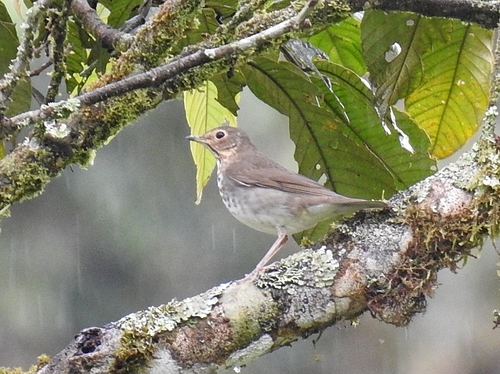 Swainson's Thrush
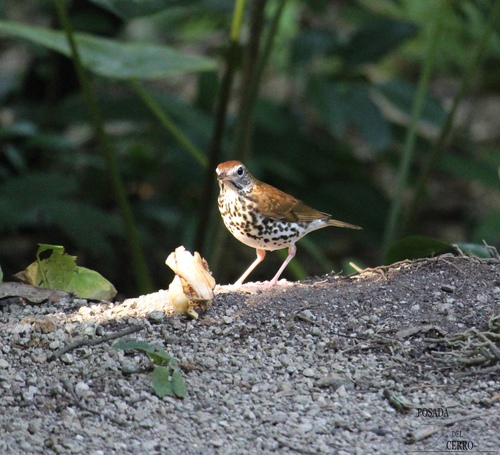 Wood Thrush
In short
The most reliable field mark to separate Swainson's Thrush from Wood Thrush is the pattern and boldness of the breast spots: Swainson's has finer, more diffuse spotting, while Wood Thrush shows large, bold, dark spots on a white breast and flanks. Wood Thrush is also noticeably larger and more robust, with a warmer cinnamon crown and nape, compared to the more uniformly olive or russet upperparts of Swainson's. Both have white eye rings and pink legs, but Wood Thrush's overall size and heavy spotting are hard to miss. In flight, both show typical thrush underwing patterns, but size and jizz differences are apparent. Juvenile Wood Thrushes have extra spotting on the back and wing coverts, which Swainson's never shows.
Identification tips
- Breast spotting: Wood Thrush always shows large, bold, dark spots on a white breast, sides, and flanks. Swainson's Thrush has much finer, blurrier, and more diffuse brown spots, mostly on the upper breast.
- Juvenile marks: Juvenile Wood Thrushes have extra spots on the back, neck, and wing coverts, giving a scaly or speckled look above. Swainson's juveniles never show these dorsal spots.
- Head and upperparts color: Wood Thrush has a rich cinnamon-brown crown and nape, contrasting with a duller brown back. Swainson's Thrush is more uniformly colored above: olive-brown in the east, russet-brown in the west, with no strong contrast between crown and back.
- Eye ring: Both have pale eye rings, but Swainson's is more prominent and buffy, often described as 'spectacled.' Wood Thrush's eye ring is less contrasting against the warm cinnamon head.
- Size and structure: Wood Thrush is noticeably larger, bulkier, and more robust, with a heavier bill and thicker neck. Swainson's is slimmer and more delicate, with a finer bill.
- Leg color: Both have pink legs, so this is not a useful separator.
- Underwing pattern: Both show the typical Catharus white-dark-white underwing pattern, so this is not diagnostic between the two.
- Tail and wing shape: Wood Thrush has a slightly longer wing chord and a more robust tail, but these are subtle in the field.
- Habitat: In breeding season, Wood Thrush is usually found in mature, moist deciduous forests with dense understory. Swainson's prefers coniferous or mixed forests with thick undergrowth, especially in the north and west. During migration, Swainson's may be found in a wider range of shrubby or edge habitats.
- Behavior: Both forage on the ground, but Wood Thrush is more likely to be solitary and territorial, while Swainson's can be seen in denser thickets or moving through shrubs.
- Song: Swainson's song is a spiraling, ascending flute-like series of notes. Wood Thrush's song is richer, with clear, bell-like, echoing phrases. If you hear a truly haunting, echoing song, it's likely Wood Thrush.
- Flight jizz: In flight, Wood Thrush appears bulkier and more powerful; Swainson's is lighter and more agile.
- Season: Both species are migratory, but Wood Thrush is more likely in the east and in mature forests, while Swainson's is more widespread in migration and breeds farther north and west.
- Pitfalls: Immature Wood Thrushes can look especially spotted above, which Swainson's never does. Swainson's can appear warmer or duller depending on subspecies, so don't rely on upperpart color alone.
- Overlap: Where both occur, always check the size and boldness of breast spots first, then head color and overall structure.
Size
Wood Thrush is distinctly larger and heavier than Swainson's Thrush. Wood Thrush measures 18–21.5 cm in length, with a wingspan of 30–40 cm and a body mass of 48–72 g. In contrast, Swainson's Thrush is 16–20 cm long, with a wingspan around 30 cm and a body mass of 23–45 g. The Wood Thrush is bulkier, with a longer wing chord and slightly longer bill and tarsus. In the field, Wood Thrush looks stockier and more robust, while Swainson's appears slimmer and more delicate.
Plumage
- Juvenile/immature birds: Juvenile Wood Thrushes have additional spots on the back, neck, and wing coverts, making them look even more boldly marked than adults. Swainson's Thrush juveniles lack these extra dorsal spots and have a more uniform back.
- Adults: Swainson's Thrush is brown above (olive-brown in the east, russet-brown in the west) with a pale, buffy eye ring and fine, blurry brown spots on a pale breast. Wood Thrush has a rich cinnamon-brown crown and nape, with the back, wings, and tail a duller brown. Its underparts are white with large, well-defined dark brown spots on the breast, sides, and flanks. Both species have white eye rings and pink legs, but the Wood Thrush's eye ring is less contrasting due to the warm head color. In flight, both show the typical Catharus underwing pattern (white-dark-white), but Wood Thrush's larger size and heavier build are apparent.
Behaviour
Both species forage on or near the ground, flipping leaves to find insects. Wood Thrush is primarily solitary and often seen hopping in leaf litter under dense forest canopy, sometimes joining mixed-species flocks in winter. Swainson's Thrush also forages low but may be more likely to be seen in denser, shrubbier thickets, especially during migration. Wood Thrushes defend breeding and sometimes winter feeding territories, showing territorial displays like wing and tail flicks, and can be aggressive if provoked.
Habitat
Wood Thrush prefers mature, moist deciduous or mixed forests with a dense understory, often in the eastern US and southern Canada. Swainson's Thrush is more flexible, breeding in coniferous or mixed forests, often with dense undergrowth, and is more likely to be encountered in shrubby edges, riparian thickets, or during migration in a wider range of wooded habitats. While both can overlap in migration, Wood Thrush is more tied to mature forest interiors, whereas Swainson's is common in younger, denser, or more northern woods.
Voice
Both species are renowned for their beautiful songs, but they differ in quality. Swainson's Thrush sings a series of flute-like, spiraling, ascending notes, often described as ethereal and upward-spiraling. Wood Thrush's song is richer and more complex, with clear, bell-like phrases and a haunting, echoing quality, often considered the most beautiful of North American birds. Both sing at dawn and dusk, but the song structure and tone are quite distinct if heard well.