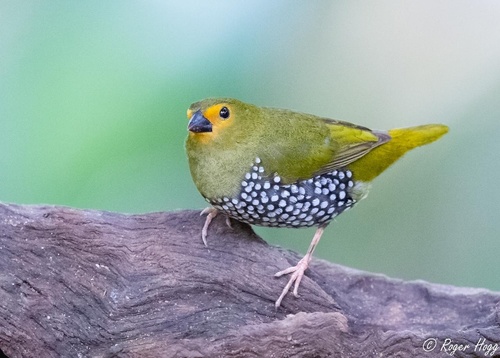
Swee Waxbill vs Green-backed Twinspot
Coccopygia melanotis versus Mandingoa nitidula
Play a quiz with Swee Waxbill and Green-backed Twinspot
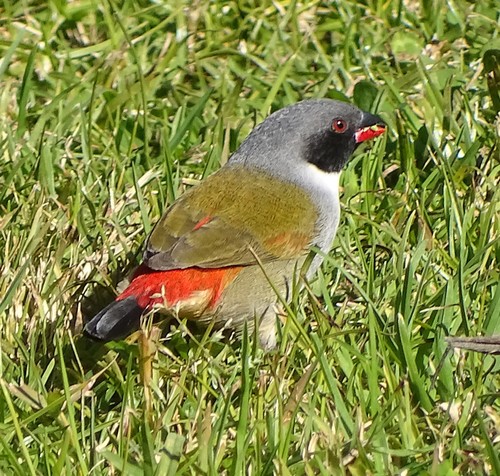
Swee Waxbill
Green-backed Twinspot
In short
To distinguish between the Swee Waxbill and the Green-backed Twinspot, focus on the plumage patterns and bill color. The Swee Waxbill has a distinctive black face with a white band and a red lower bill, while the Green-backed Twinspot features a more uniform green back and lacks the contrasting face markings.
Identification tips
- Look for the black face with a white band on the Swee Waxbill, absent in the Green-backed Twinspot.
- Check the bill color: Swee Waxbill has a red lower bill, while the Green-backed Twinspot typically has a more uniform bill.
- Observe the rump color: Swee Waxbill has a bright red rump, which is a key distinguishing feature.
- Listen for vocalizations: Swee Waxbill's distinct calls can aid in identification.
Size
Both species are similar in size, around 9–10 cm, making size an unreliable differentiator.
Plumage
The Swee Waxbill has a grey crown and nape, olive-green back, bright red rump, and a black face with a white band. In contrast, the Green-backed Twinspot has a more uniform green back and lacks the Swee Waxbill's contrasting face markings.
Behaviour
Both species forage in pairs or small groups, primarily feeding on small seeds and insects.
Voice
The Swee Waxbill's calls include a soft whistled "see-see" or "swee-swee" and a sharp "teerrrr" alarm call. The Green-backed Twinspot's vocalizations are less documented, making this a less reliable field mark.