Birdr

Sykes's Warbler vs Eastern Olivaceous Warbler

Iduna rama versus Iduna pallida

Play a quiz with Sykes's Warbler and Eastern Olivaceous Warbler
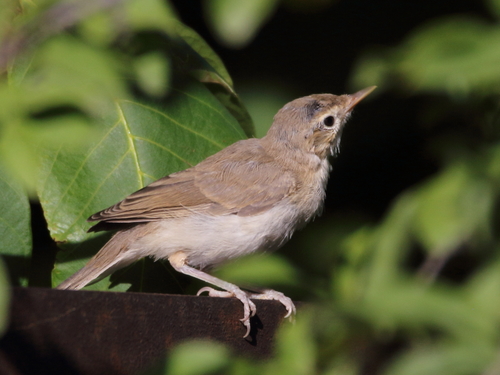
Sykes's Warbler (Iduna rama) Sykes's Warbler
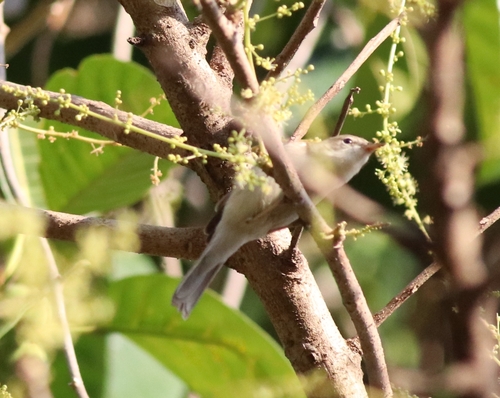
Eastern Olivaceous Warbler (Iduna pallida) Eastern Olivaceous Warbler

Media

Loading…

In short

Sykes's Warbler and Eastern Olivaceous Warbler are similar in appearance but can be distinguished by structural features and vocalizations. Sykes's Warbler typically has a shorter primary projection and a more rounded wing shape compared to the longer primary projection of the Eastern Olivaceous Warbler. Vocal differences are also notable, with Sykes's Warbler having a more varied song.

Identification tips

  1. Primary projection: Sykes's Warbler has a shorter primary projection compared to Eastern Olivaceous Warbler. 2. Wing shape: Sykes's Warbler has a more rounded wing shape. 3. Supercilium: More pronounced in Eastern Olivaceous Warbler. 4. Song: Listen for the more varied song of Sykes's Warbler. 5. Habitat: Consider the habitat, with Sykes's favoring drier, open areas.

Size

Both species are similar in size, typical of small warblers, making size an unreliable differentiator.

Plumage

Both species exhibit similar overall plumage tones with subtle brownish-olive upperparts and paler underparts. The supercilium is present in both but tends to be more pronounced in the Eastern Olivaceous Warbler.

Behaviour

Both species are active and often seen foraging in low vegetation. Behavioral differences are subtle and not reliable for field identification.

Habitat

Sykes's Warbler is more often found in drier, open scrub habitats, while Eastern Olivaceous Warbler prefers slightly more vegetated areas, though there is significant overlap.

Voice

Sykes's Warbler has a more varied and complex song compared to the simpler, more repetitive song of the Eastern Olivaceous Warbler. Calls are similar and not easily distinguished without experience.

Submit a better description

Use the same sections as the comparison. Your text is published immediately.

Sykes's Warbler and Eastern Olivaceous Warbler are similar in appearance but can be distinguished by structural features and vocalizations. Sykes's Warbler typically has a shorter primary projection and a more rounded wing shape compared to the longer primary projection of the Eastern Olivaceous Warbler. Vocal differences are also notable, with Sykes's Warbler having a more varied song.

  1. Primary projection: Sykes's Warbler has a shorter primary projection compared to Eastern Olivaceous Warbler. 2. Wing shape: Sykes's Warbler has a more rounded wing shape. 3. Supercilium: More pronounced in Eastern Olivaceous Warbler. 4. Song: Listen for the more varied song of Sykes's Warbler. 5. Habitat: Consider the habitat, with Sykes's favoring drier, open areas.

Both species are similar in size, typical of small warblers, making size an unreliable differentiator.

Both species exhibit similar overall plumage tones with subtle brownish-olive upperparts and paler underparts. The supercilium is present in both but tends to be more pronounced in the Eastern Olivaceous Warbler.

Both species are active and often seen foraging in low vegetation. Behavioral differences are subtle and not reliable for field identification.

Sykes's Warbler is more often found in drier, open scrub habitats, while Eastern Olivaceous Warbler prefers slightly more vegetated areas, though there is significant overlap.

Sykes's Warbler has a more varied and complex song compared to the simpler, more repetitive song of the Eastern Olivaceous Warbler. Calls are similar and not easily distinguished without experience.

Discard your changes?

You have unsaved edits. If you leave now, those changes will be lost.

Sykes's Warbler · Eastern Olivaceous Warbler · My Tricky Birds