
Taiga Bean Goose vs Tundra Bean Goose
Anser fabalis versus Anser serrirostris
Play a quiz with Taiga Bean Goose and Tundra Bean Goose
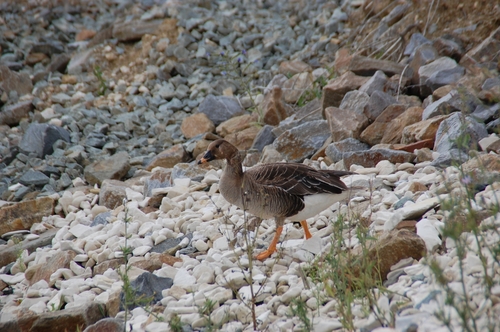 Taiga Bean Goose
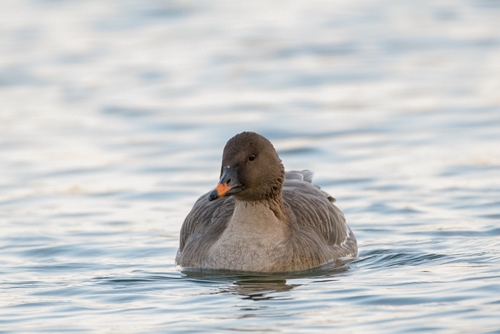 Tundra Bean Goose
In short
Separating Taiga and Tundra Bean Goose in the field is challenging, as both are large, dark-billed geese with orange legs and a similar overall look. The most reliable mark is bill structure: Taiga Bean Goose typically has a longer, more slender bill with a broader orange band, while Tundra Bean Goose (especially the rossicus subspecies) shows a shorter, stubbier bill with a narrower orange band. Both species have dark brown upperwing-coverts with narrow white fringes, and their body size and plumage are extremely similar, so close study of bill shape and size is essential. Age-specific wing patterns are not distinct between these two, so focus on structure and subtle differences in bill pattern, especially in mixed flocks.
Identification tips
- Bill structure is the key field mark: Taiga Bean Goose typically has a longer, more slender bill with a broader orange band, while Tundra Bean Goose (especially rossicus) has a shorter, stubbier bill with a narrower orange band. This is most reliable in close views or photos.
- Bill color pattern: Both species have black at the base and tip, with an orange band across the middle, but the width of the orange band is generally greater in Taiga. In Tundra, the orange can appear more restricted and sometimes less vivid.
- Upperwing-coverts: Both species have dark brown upperwing-coverts with narrow white fringes. There are no age-specific wing patterns to separate them, so this is not useful for ID.
- Leg and foot color: Both species have bright orange legs and feet; this is not a separator.
- Overall plumage: Both are brownish-grey geese with paler bellies and similar patterning. No consistent plumage difference exists between them.
- Size and shape: Both are large geese with overlapping size ranges. Do not rely on overall size or bulk for separation.
- Subspecies confusion: The Tundra Bean Goose subspecies rossicus is especially similar to Taiga Bean Goose in size and bill structure, making identification even more difficult. Only the most extreme individuals are safely identified.
- Beware Pink-footed Goose: If present, Pink-footed Goose has a short, pink-centered bill and pink feet, and paler, greyer upperwing-coverts. Do not confuse these marks with the orange-billed bean geese.
- Mixed flocks: Both species may occur together in winter. Check multiple individuals and look for the full range of bill shapes and sizes; some birds may be intermediate or not safely identified.
- Voice is not diagnostic: No consistent vocal differences are described in the sources, so do not rely on calls for separation.
- Habitat overlap: Both species use similar habitats in winter and migration, so context is not helpful for ID.
- No age-specific flight marks: Unlike some other geese, there are no distinctive juvenile or immature wing patterns to separate these two; all ages look similar in flight.
- Photographic review: When possible, use photos to study bill shape and orange band width, as field views can be misleading due to angle or distance.
- Field guides and expert opinion: Many field guides note that separation is often uncertain except in classic examples; be honest about uncertainty and avoid overconfidence.
- If in doubt, leave as 'Bean Goose sp.': Given the overlap and subtlety of differences, it is acceptable to record birds as 'Bean Goose sp.' when identification is not clear.
Size
Both species are very similar in size, with overlapping ranges for length (68–90 cm), wingspan (140–174 cm), and weight (1.7–4 kg). The average body mass for Taiga Bean Goose is about 3020.5 g [wikidata], but this is not a reliable field mark as Tundra Bean Goose falls within the same range. There is no consistent size difference in the field; both sexes and all ages overlap in bulk and length, so size alone should not be used for identification.
Plumage
Plumage differences between Taiga and Tundra Bean Goose are minimal and not reliably diagnostic in the field. Both species have dark brown upperwing-coverts with narrow white fringes, and this pattern is consistent across all ages (juvenile, immature, and adult). There are no unique juvenile or immature wing markings to separate the two. The main visual difference is in the bill: Taiga Bean Goose usually shows a longer, more slender bill with a broader orange band, while Tundra Bean Goose (especially rossicus) has a shorter, stubbier bill with a narrower orange band. Both have bright orange legs and feet. In all plumages, beware confusion with Pink-footed Goose, which has a pink bill and feet and paler, greyer upperwing-coverts.
Behaviour
Both species behave similarly, foraging in flocks on open ground and flying in loose skeins. There are no behavioral differences noted in the sources that are useful for field separation. Flight style, flocking, and feeding behavior are essentially identical.
Habitat
Taiga Bean Goose breeds in northern Europe and Asia, while Tundra Bean Goose breeds in northern Siberia. Both are migratory and winter further south, often overlapping in wintering grounds. In mixed flocks, habitat is not a reliable separator. Both species use similar wetland and agricultural habitats during migration and winter.
Voice
The notes only mention that Taiga Bean Goose has a loud honking call, but do not provide a comparison with Tundra Bean Goose. No diagnostic vocal differences are described in the sources provided.