Birdr

Tawny-faced Gnatwren vs Long-billed Gnatwren

Microbates cinereiventris versus Ramphocaenus melanurus

Play a quiz with Tawny-faced Gnatwren and Long-billed Gnatwren

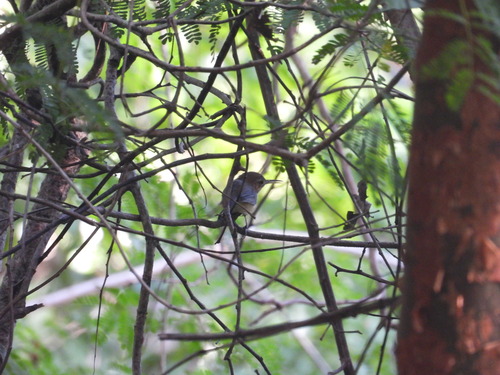
Tawny-faced Gnatwren (Microbates cinereiventris) Tawny-faced Gnatwren
Long-billed Gnatwren (Ramphocaenus melanurus) Long-billed Gnatwren

Media

Loading…

In short

The Tawny-faced Gnatwren and Long-billed Gnatwren can be distinguished by bill length and facial coloration. The Tawny-faced has a shorter bill and a distinctive tawny face, while the Long-billed features a notably longer bill and lacks the tawny facial coloration. Both species are elusive and often remain hidden in dense vegetation.

Identification tips

  1. Look for the tawny face on the Tawny-faced Gnatwren. 2. Note the bill length: the Long-billed Gnatwren has a significantly longer bill. 3. Observe tail behavior: the Long-billed Gnatwren often cocks its tail up and twitches it. 4. Listen for vocalizations: the Long-billed's trilling song versus the Tawny-faced's whiny calls.

Size

Both species are similar in size, small and wren-like.

Plumage

The Tawny-faced Gnatwren has a tawny face, which is a key distinguishing feature, while the Long-billed Gnatwren generally has dull to warm brown upperparts and lacks the tawny facial coloration.

Behaviour

Both species are active and often remain hidden in dense undergrowth. The Long-billed Gnatwren has a distinctive behavior of cocking its tail up and twitching it, which is less pronounced in the Tawny-faced.

Habitat

Both species inhabit dense undergrowth, but the Long-billed Gnatwren has a broader range, found from southern Mexico to northern South America, whereas the Tawny-faced is more localized.

Voice

The Long-billed Gnatwren is best located by its rattled, trilling song, while the Tawny-faced Gnatwren occasionally gives whiny calls but is often difficult to hear.

Submit a better description

Use the same sections as the comparison. Your text is published immediately.

The Tawny-faced Gnatwren and Long-billed Gnatwren can be distinguished by bill length and facial coloration. The Tawny-faced has a shorter bill and a distinctive tawny face, while the Long-billed features a notably longer bill and lacks the tawny facial coloration. Both species are elusive and often remain hidden in dense vegetation.

  1. Look for the tawny face on the Tawny-faced Gnatwren. 2. Note the bill length: the Long-billed Gnatwren has a significantly longer bill. 3. Observe tail behavior: the Long-billed Gnatwren often cocks its tail up and twitches it. 4. Listen for vocalizations: the Long-billed's trilling song versus the Tawny-faced's whiny calls.

Both species are similar in size, small and wren-like.

The Tawny-faced Gnatwren has a tawny face, which is a key distinguishing feature, while the Long-billed Gnatwren generally has dull to warm brown upperparts and lacks the tawny facial coloration.

Both species are active and often remain hidden in dense undergrowth. The Long-billed Gnatwren has a distinctive behavior of cocking its tail up and twitching it, which is less pronounced in the Tawny-faced.

Both species inhabit dense undergrowth, but the Long-billed Gnatwren has a broader range, found from southern Mexico to northern South America, whereas the Tawny-faced is more localized.

The Long-billed Gnatwren is best located by its rattled, trilling song, while the Tawny-faced Gnatwren occasionally gives whiny calls but is often difficult to hear.

Discard your changes?

You have unsaved edits. If you leave now, those changes will be lost.

Tawny-faced Gnatwren · Long-billed Gnatwren · My Tricky Birds