
Temminck's Stint vs Dunlin
Calidris temminckii versus Calidris alpina
Play a quiz with Temminck's Stint and Dunlin
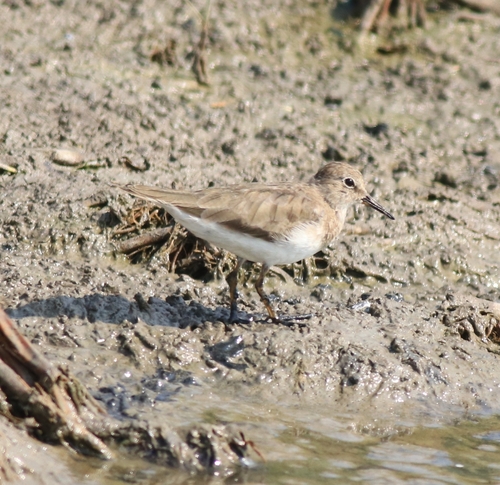 Temminck's Stint
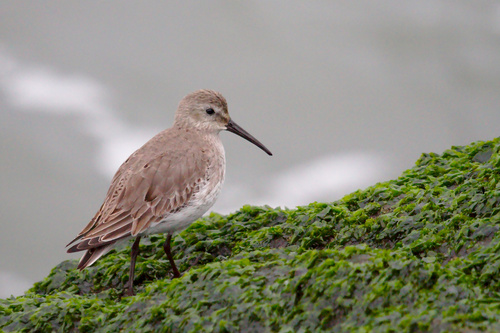 Dunlin
In short
The most reliable field mark to separate Temminck's Stint from Dunlin is the leg and outer tail color: Temminck's Stint has dull yellowish or brown legs and white outer tail feathers, while Dunlin has black legs and grey outer tail feathers. In flight, Dunlin of all ages show a narrow white wingbar, which Temminck's Stint lacks. Dunlin is notably larger and stouter, with a longer, decurved black bill, whereas Temminck's Stint is smaller, slimmer, and has a finer, straight bill. Breeding Dunlin have a distinctive black belly patch, never shown by Temminck's Stint. Winter and juvenile plumages can be confusing, but careful attention to structure, leg color, and flight patterns will resolve most mix-ups.
Identification tips
- Leg color: Temminck's Stint always has dull yellowish or brown legs, while Dunlin's legs are black. This is a key separation point at close range, especially when birds are standing or wading.
- Outer tail feathers: In flight, Temminck's Stint shows white outer tail feathers; Dunlin's are grey. This can be seen when the bird fans its tail or takes off.
- White wingbar (in flight): Dunlin of all ages show a narrow white wingbar in flight, which Temminck's Stint lacks. If you see a white stripe across the wing, it's Dunlin.
- Bill shape and length: Dunlin has a longer, slightly decurved black bill (females' bills are even longer), while Temminck's Stint has a shorter, finer, straight bill. Bill shape is especially helpful when birds are feeding side by side.
- Size and structure: Dunlin is larger, bulkier, and stouter, with a more robust appearance. Temminck's Stint is smaller, slimmer, and more delicate, with a shorter neck and legs.
- Breeding plumage: Only Dunlin shows a bold black belly patch in breeding plumage. Temminck's Stint never has a black belly, only a slightly darker breast.
- Juvenile/immature back pattern: Juvenile Dunlin have two weak whitish 'V' marks on the back (less obvious than in Little Stint), while Temminck's Stint juveniles are plainer above and lack strong back markings.
- Leg length: Temminck's Stint is shorter-legged than Dunlin, which can be noticeable when both are wading in shallow water.
- Feeding behavior: Dunlin feeds with a rapid, 'sewing machine' action, methodically probing the mud. Temminck's Stint is more delicate and less persistent in its feeding movements.
- Flocking: Large, dense, synchronized flocks are typical of Dunlin, especially in winter. Temminck's Stint is usually solitary or in small groups.
- Habitat: Dunlin is more likely on open coastal mudflats and beaches; Temminck's Stint prefers muddy or vegetated freshwater margins.
- Bill tip: Dunlin's bill tip is blunt (not sharp), with a soft, sensitive covering for probing. This is subtle but can be seen at close range.
- Flank/belly markings (juvenile): Juvenile Dunlin often show black marks on the flanks or belly, which Temminck's Stint lacks.
- Seasonal confusion: In winter, both species are duller, but leg color, bill shape, and flight pattern (wingbar) remain reliable.
- Voice: Dunlin gives a 'chreep' call and harsh trill in display, but Temminck's Stint's voice is not described here, so use other marks first.
Size
Temminck's Stint is significantly smaller and lighter than Dunlin. Temminck's Stint measures 13.5–15 cm in length and has a body mass around 26 g, while Dunlin is larger at 16–20 cm and weighs 34–77 g. Dunlin also appears bulkier and has a longer wingspan (38–43 cm vs. Temminck's Stint's proportionally shorter wings). In mixed flocks, Dunlin will stand out as the larger, more robust bird, while Temminck's Stint looks daintier and more delicate.
Plumage
-
Juvenile/First-winter/Immature in flight: Dunlin of all ages show a narrow white wingbar in flight, which Temminck's Stint lacks. Juvenile Dunlin have brown upperparts with two weak whitish 'V' marks on the back (less obvious than in Little Stint), and often show black marks on the flanks or belly. Temminck's Stint juveniles are plainer brown above and white below, lacking strong back markings or wingbars.
-
Adult breeding plumage: Dunlin is unmistakable with its bold black belly patch, rufous upperparts, and black legs. Temminck's Stint is much drabber, with plain brown upperparts, a slightly darker breast, and yellowish or brown legs, sometimes with a few rufous or blackish mantle feathers but never a black belly.
-
Non-breeding/winter plumage: Both species become duller, but Temminck's Stint remains plain brownish-grey above and white below, with yellowish/brown legs and white outer tail. Dunlin is greyish-brown above and white below, with black legs and a slightly decurved black bill. The white wingbar in flight remains a key difference for Dunlin.
Behaviour
Dunlin is highly gregarious in winter, often forming large, synchronized flocks on coastal mudflats and beaches, and feeding with a distinctive 'sewing machine' action. Temminck's Stint is less gregarious, typically seen singly or in small groups, and does not show the same tight flocking or synchronized flight behavior. Dunlin's feeding is more methodical and persistent, while Temminck's Stint appears more delicate and less robust in its movements.
Habitat
Both species are waders, but Dunlin is much more likely to be found in large numbers on open coastal mudflats or sandy beaches, especially outside the breeding season. Temminck's Stint prefers smaller, often more vegetated or muddy margins of freshwater or brackish pools, and is less likely to be seen in large coastal flocks. If you see a small wader in a huge, swirling flock on a tidal flat, it's almost certainly Dunlin.
Voice
Dunlin gives a typical sandpiper 'chreep' call and a harsh trilling display song. There is no specific vocal description for Temminck's Stint in the notes, so voice is not a reliable separator here.