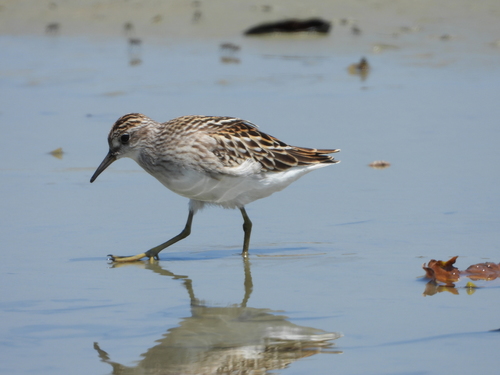
Temminck's Stint vs Long-toed Stint
Calidris temminckii versus Calidris subminuta
Play a quiz with Temminck's Stint and Long-toed Stint
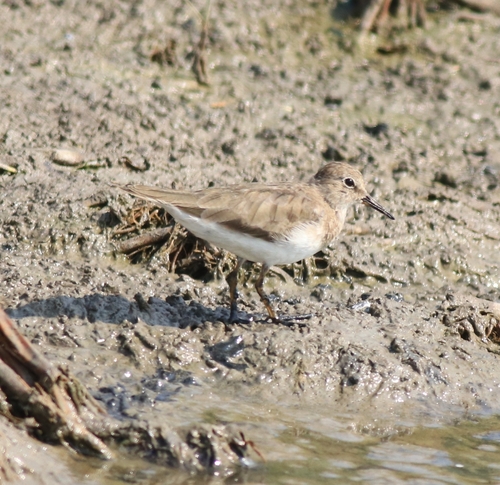
Temminck's Stint
Long-toed Stint
In short
The Long-toed Stint (Calidris subminuta) and Temminck's Stint (Calidris temminckii) are both small waders that can be confused due to their similar sizes and habitats. However, they can be distinguished by their plumage coloration, vocalizations, and behaviors, with the Long-toed Stint exhibiting longer toes that project beyond its tail in flight and a distinctive rufous crown, while Temminck's Stint has a more uniform appearance and a unique vocalization pattern.
Identification tips
- Birds of the World Similar-Species Diagnostics:
-
The expert source highlights that the Long-toed Stint has long toes that project beyond the tail in flight, while the Temminck's Stint has broad white sides to the tail and a more uniform plumage pattern. The vocalizations are also distinct, with the Long-toed Stint producing a variety of calls, unlike the simpler calls of the Temminck's Stint.
-
AI Field Diagnostics:
- Toes: Look for the Long-toed Stint's noticeably longer toes that extend beyond the tail in flight—this is a key field indicator.
- Plumage Coloration: Focus on the rufous crown and ear-coverts of the Long-toed Stint compared to the more uniform, greyish tones of the Temminck's Stint.
- Vocalizations: Listen for the Long-toed Stint’s varied calls versus the sharp, single “tirr” call of the Temminck's Stint, which can help differentiate them when observing in the field.
- Behavior and Habitat: Note the Long-toed Stint's preference for marshy inland habitats versus the more versatile habitat preference of the Temminck's Stint, which can often be found in coastal areas.
By paying attention to these details, birdwatchers can successfully identify and differentiate between the Long-toed Stint and Temminck's Stint in the field.
Size
- Long-toed Stint: Measures 13–16 cm in length, weighs 20–37 g, and has a wingspan of 26–35 cm.
- Temminck's Stint: Slightly smaller, measuring 13–15 cm in length, weighing 15–36 g, and has a wingspan of 34–37 cm.
- Body Proportions: The Long-toed Stint is characterized by a relatively longer neck, legs, and toes, making it appear less compact than the shorter-legged Temminck's Stint.
Plumage
- Long-toed Stint:
- Breeding plumage features a rufous crown and ear-coverts with dark streaks, a prominent whitish supercilium, and fine dark streaking on the neck and breast. The upperparts are dark brown with rufous and pale buff fringes, and the long toes project beyond the tail in flight.
-
Non-breeding adults have grey upperparts and a suffused grey-brown breast.
-
Temminck's Stint:
- Breeding plumage consists of a more uniform dull grey to olive-brown coloration with heavily streaked brown on the breast and broad white sides to the tail and rump. Non-breeding adults have a plain dark grey upperpart and a uniform pale grey-brown breast.
- The Temminck's Stint lacks the rufous coloration of the Long-toed Stint and has a generally less striking plumage.
Behaviour
- Long-toed Stint: Displays a more compact flight style, with longer toes making it appear graceful. It is often seen foraging alone or in small groups.
- Temminck's Stint: Exhibits a unique display flight, characterized by slow, rhythmic flying with a V-shaped wing position, often hovering in the wind. It tends to forage in small groups and is more likely to be seen in flocks.
Habitat
- Long-toed Stint: Prefers marshy areas, wet grasslands, and mudflats, often found in more inland and freshwater habitats.
- Temminck's Stint: Typically inhabits a broader range of environments, including coastal mudflats, wetlands, and even inland sites such as fields and riverbanks.
Voice
- Long-toed Stint: Its vocalizations include a series of purring calls and various flight calls, like a trilling “chee” or a rolling “kurrip”.
- Temminck's Stint: Known for its sharp, clear alarm call “tirr” or “trrrrit” and a sustained trilling song during display flights, likened to the Common Grasshopper Warbler.