Birdr

Tennessee Warbler vs Hooded Warbler

Leiothlypis peregrina versus Setophaga citrina

Play a quiz with Tennessee Warbler and Hooded Warbler
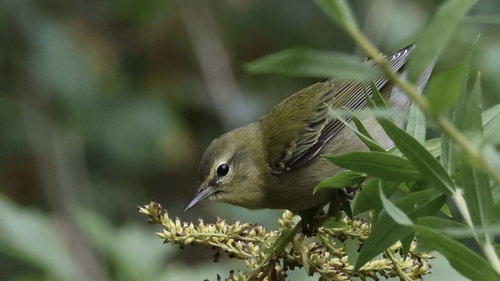
Tennessee Warbler (Leiothlypis peregrina) Tennessee Warbler
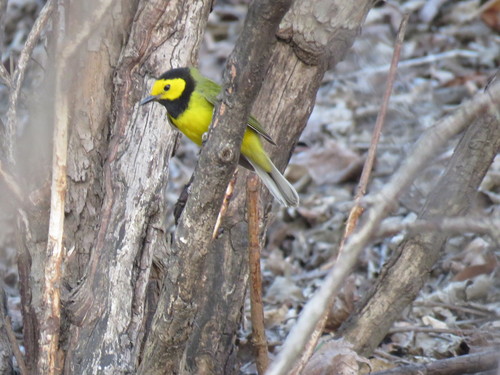
Hooded Warbler (Setophaga citrina) Hooded Warbler

Media

Loading…

In short

The Tennessee Warbler and Hooded Warbler can be distinguished by behavior and plumage. The Hooded Warbler has a distinctive black hood and white tail spots, while the Tennessee Warbler is more uniformly greenish with no hood. Behaviorally, the Hooded Warbler flicks its tail to reveal white spots, a trait absent in the Tennessee Warbler.

Identification tips

Size

Both species are small warblers, but the Hooded Warbler may appear slightly larger due to its longer tail.

Plumage

The Tennessee Warbler is generally greenish above and pale below, lacking distinctive facial markings. In contrast, the Hooded Warbler has a striking black hood (in males) and bright yellow face, with white spots on the tail visible during tail flicking.

Behaviour

The Hooded Warbler frequently flicks its tail to reveal white spots, a behavior not observed in the Tennessee Warbler. This tail-flicking is a key behavioral trait for identification.

Habitat

Tennessee Warblers are often found in remote, logged areas during breeding, while Hooded Warblers prefer dense understory in forest gaps or edges. Both species migrate, but their specific habitats differ significantly.

Voice

The Hooded Warbler has a distinctive song with individually recognizable variations, while the Tennessee Warbler's song is less distinctive. Specific vocal differences are not detailed here.

Submit a better description

Use the same sections as the comparison. Your text is published immediately.

The Tennessee Warbler and Hooded Warbler can be distinguished by behavior and plumage. The Hooded Warbler has a distinctive black hood and white tail spots, while the Tennessee Warbler is more uniformly greenish with no hood. Behaviorally, the Hooded Warbler flicks its tail to reveal white spots, a trait absent in the Tennessee Warbler.

  • Look for the black hood: Only the Hooded Warbler has this feature.
  • Observe tail behavior: Hooded Warblers flick their tails to show white spots.
  • Check habitat: Hooded Warblers prefer dense understory, while Tennessee Warblers are found in logged areas.
  • Listen for song: Hooded Warblers have distinctive, variable songs.

Both species are small warblers, but the Hooded Warbler may appear slightly larger due to its longer tail.

The Tennessee Warbler is generally greenish above and pale below, lacking distinctive facial markings. In contrast, the Hooded Warbler has a striking black hood (in males) and bright yellow face, with white spots on the tail visible during tail flicking.

The Hooded Warbler frequently flicks its tail to reveal white spots, a behavior not observed in the Tennessee Warbler. This tail-flicking is a key behavioral trait for identification.

Tennessee Warblers are often found in remote, logged areas during breeding, while Hooded Warblers prefer dense understory in forest gaps or edges. Both species migrate, but their specific habitats differ significantly.

The Hooded Warbler has a distinctive song with individually recognizable variations, while the Tennessee Warbler's song is less distinctive. Specific vocal differences are not detailed here.

Discard your changes?

You have unsaved edits. If you leave now, those changes will be lost.

Tennessee Warbler · Hooded Warbler · My Tricky Birds