
Birdr

Thick-billed Spiderhunter vs Little Spiderhunter

Arachnothera crassirostris versus Arachnothera longirostra

Play a quiz with Thick-billed Spiderhunter and Little Spiderhunter

Thick-billed Spiderhunter (Arachnothera crassirostris) Thick-billed Spiderhunter
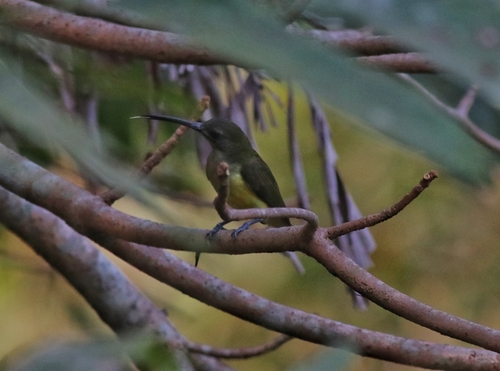
Little Spiderhunter (Arachnothera longirostra) Little Spiderhunter

Media

Loading…

In short

The Thick-billed Spiderhunter and Little Spiderhunter are similar in appearance but can be distinguished by bill size and shape. The Thick-billed has a notably heavier and thicker bill compared to the more slender bill of the Little Spiderhunter. Both species share similar habitats but differ slightly in vocalizations.

Identification tips

  1. Bill Size: Look for the thicker, heavier bill of the Thick-billed Spiderhunter. 2. Size and Structure: Note the slightly larger size and more robust build of the Thick-billed. 3. Vocalizations: Listen for the harsher calls of the Thick-billed compared to the softer calls of the Little Spiderhunter. 4. Habitat: Consider the elevation; the Thick-billed is more common in montane areas.

Size

The Thick-billed Spiderhunter is slightly larger and more robust than the Little Spiderhunter.

Plumage

Both species have similar plumage with olive-green upperparts and yellowish underparts, making color a less reliable distinguishing feature.

Behaviour

Both species exhibit similar foraging behavior, often seen probing flowers for nectar.

Habitat

Both species inhabit similar forested areas, but the Thick-billed Spiderhunter is more often found in lower montane forests, while the Little Spiderhunter is more widespread in lowland forests.

Voice

The Thick-billed Spiderhunter has a harsher, more metallic call compared to the softer, more musical call of the Little Spiderhunter.

Submit a better description

Use the same sections as the comparison. Your text is published immediately.

The Thick-billed Spiderhunter and Little Spiderhunter are similar in appearance but can be distinguished by bill size and shape. The Thick-billed has a notably heavier and thicker bill compared to the more slender bill of the Little Spiderhunter. Both species share similar habitats but differ slightly in vocalizations.

  1. Bill Size: Look for the thicker, heavier bill of the Thick-billed Spiderhunter. 2. Size and Structure: Note the slightly larger size and more robust build of the Thick-billed. 3. Vocalizations: Listen for the harsher calls of the Thick-billed compared to the softer calls of the Little Spiderhunter. 4. Habitat: Consider the elevation; the Thick-billed is more common in montane areas.

The Thick-billed Spiderhunter is slightly larger and more robust than the Little Spiderhunter.

Both species have similar plumage with olive-green upperparts and yellowish underparts, making color a less reliable distinguishing feature.

Both species exhibit similar foraging behavior, often seen probing flowers for nectar.

Both species inhabit similar forested areas, but the Thick-billed Spiderhunter is more often found in lower montane forests, while the Little Spiderhunter is more widespread in lowland forests.

The Thick-billed Spiderhunter has a harsher, more metallic call compared to the softer, more musical call of the Little Spiderhunter.

Discard your changes?

You have unsaved edits. If you leave now, those changes will be lost.

Thick-billed Spiderhunter · Little Spiderhunter · My Tricky Birds