Birdr

Three-banded Courser vs Burchell's Courser

Rhinoptilus cinctus versus Cursorius rufus

Play a quiz with Three-banded Courser and Burchell's Courser
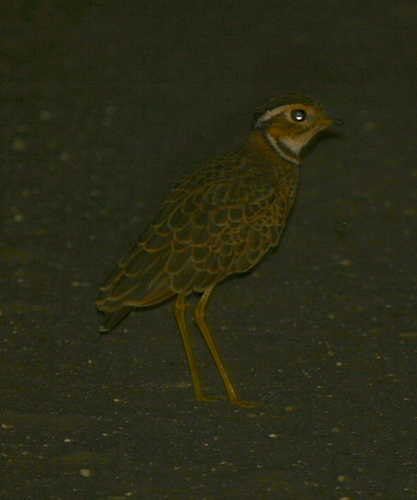
Three-banded Courser (Rhinoptilus cinctus) Three-banded Courser
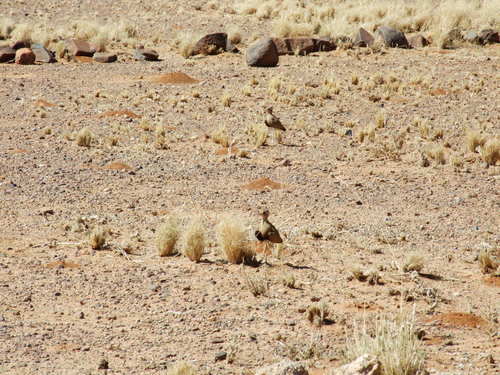
Burchell's Courser (Cursorius rufus) Burchell's Courser

Media

Loading…

In short

The Three-banded Courser and Burchell's Courser are both ground-dwelling birds of the Glareolidae family, but they can be distinguished by their facial markings and habitat preferences. The Three-banded Courser has distinctive bold facial markings, while Burchell's Courser is more uniform in appearance. Habitat preferences also differ, with the Three-banded Courser favoring woodland areas and Burchell's Courser preferring open, stony or semi-desert regions.

Identification tips

  1. Look for bold facial markings on the Three-banded Courser; Burchell's Courser has a more uniform face. 2. Observe the habitat: woodland areas suggest Three-banded Courser, while open, stony areas suggest Burchell's Courser. 3. Consider the time of day: Three-banded Courser is more active at night, whereas Burchell's Courser is active during the day.

Size

Both species are similar in size, typical of coursers, with no significant size difference noted in the field.

Plumage

The Three-banded Courser is noted for its bold facial markings, including a striking black and white pattern on the face, and intricately patterned underparts. In contrast, Burchell's Courser has a more uniform appearance with less contrasting facial markings, making it appear plainer.

Behaviour

The Three-banded Courser is primarily nocturnal and secretive, often difficult to observe. Burchell's Courser is diurnal and can be seen foraging in open areas during the day.

Habitat

Three-banded Coursers are typically found in woodland areas, while Burchell's Coursers inhabit open, stony veld, semi-deserts, and the edges of salt pans. This difference in habitat preference is a key field mark.

Submit a better description

Use the same sections as the comparison. Your text is published immediately.

The Three-banded Courser and Burchell's Courser are both ground-dwelling birds of the Glareolidae family, but they can be distinguished by their facial markings and habitat preferences. The Three-banded Courser has distinctive bold facial markings, while Burchell's Courser is more uniform in appearance. Habitat preferences also differ, with the Three-banded Courser favoring woodland areas and Burchell's Courser preferring open, stony or semi-desert regions.

  1. Look for bold facial markings on the Three-banded Courser; Burchell's Courser has a more uniform face. 2. Observe the habitat: woodland areas suggest Three-banded Courser, while open, stony areas suggest Burchell's Courser. 3. Consider the time of day: Three-banded Courser is more active at night, whereas Burchell's Courser is active during the day.

Both species are similar in size, typical of coursers, with no significant size difference noted in the field.

The Three-banded Courser is noted for its bold facial markings, including a striking black and white pattern on the face, and intricately patterned underparts. In contrast, Burchell's Courser has a more uniform appearance with less contrasting facial markings, making it appear plainer.

The Three-banded Courser is primarily nocturnal and secretive, often difficult to observe. Burchell's Courser is diurnal and can be seen foraging in open areas during the day.

Three-banded Coursers are typically found in woodland areas, while Burchell's Coursers inhabit open, stony veld, semi-deserts, and the edges of salt pans. This difference in habitat preference is a key field mark.

Discard your changes?

You have unsaved edits. If you leave now, those changes will be lost.

Three-banded Courser · Burchell's Courser · My Tricky Birds